6. Welcome to the Fleet!
No person can be a great leader unless he takes a
genuine joy in the successes of those under him.
—W. A. Nance
Talk show host Johnny Carson once remarked on The Tonight Show that his experience as an ensign in the Navy was a horrifying experience, in that his initial shipboard assignment placed him in charge of seasoned senior enlisted Navy Chief Petty Officers with many years of fleet experience, and old enough to be his father. He quipped that he felt so inexperienced in leadership as an officer that every time his senior chief approached him for instructions, he would hide in his locker due to his reeking insecurity.
Even without any formal leadership responsibilities in command training at age 24, I very much related to this insecurity upon my initial ground duty assignment as Maintenance Administration Officer with a highly-qualified Chief Petty Officer in tow.
In a Navy fleet squadron, each officer is assigned a ground job where he receives a periodic evaluation or report card called a “fitness report” from his commanding officer. There is only one grade assigned for “airmanship,” with most emphasis placed on leadership performance as a military officer while serving in his assigned ground duties.
Such leadership qualities as goal settings and achievements, subordinate management and development, response in stressful situations, speaking and writing ability, and the like, were periodically reported by the immediate superior officer to the squadron commanding officer. High grades on these “report cards” guaranteed future Naval promotions with enhanced assignments to other commands. This system generated fierce competition amongst the 60 officers assigned to each P-3 squadron, which consisted of a total of about 350 men and women.
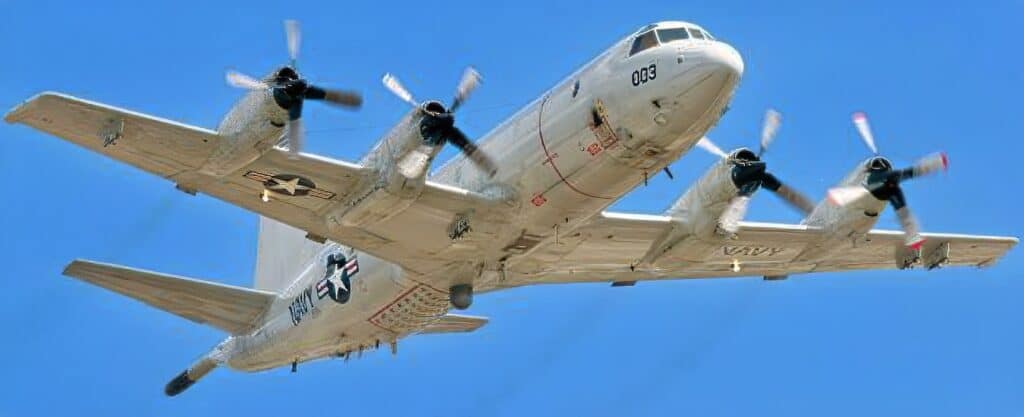
P-3 Orion: 12-man crew, sub hunter, reconnaissance, other missions
The squadron “sea tour” follows completion of the “shore tour” and is the ultimate goal of a Junior Naval Aviator who wants to be selected to command a squadron. Toward this end, each officer was ranked on his fitness report with his peer officers. Then a few in the top one-percentile were recommended for accelerated promotion, which further improved one’s chances for a career-enhancing shore tour assignment, and ultimately to command a P-3 or some other squadron in the future.
Those reaching beyond for the ranks of the aircraft carrier skippers were required to wear wings of gold as a flag officer. This ultimate goal of commanding the big grey boat is reached by only a few select squadron skippers in the fleet. This honor was usually awarded to those superlative officers with carrier operations experience who had never “stubbed their toes,” so as to receive a poor “report card” during their career.
Being a Naval Academy graduate, (dubbed a “ring knocker,” since these officers wore the Navy Academy ring), was an added plus in all future assignments. Being a ring knocker was akin to being a member of a Royal Masonic Lodge, or a Harvard, Yale, or other Ivy League college graduate in the business world. Professional brotherhoods have a long reach, and strong influences.
Becoming an instructor pilot after your P-3 squadron sea duty tour was one way to enhance your career. Another way was to get a master’s degree from the Naval Post-Graduate School in Monterrey, California, which could lead to a Pentagon desk job. Attending the Naval War College in Newport, Rhode Island, was also considered an added feather in your career cap.
In all cases, once beyond the rank of Lieutenant Commander, your flying days were basically over, as the responsibilities and requirements of your ground job superseded your priority to fly airplanes, which left most 40-year-old aviators “flying a desk” for the remainder of their Naval career.
I wanted to fly airplanes!
Unlike the training command, fleet squadron life, with all its competition, was quite a different animal. With six years of flying experience behind me, I still had four years of military duty ahead of me. Rather than map my course toward a desk job for life, I vowed to continue in my “work and play hard” vein, with the hope that I could still find myself in the cockpit of a commercial jet at the end of my Naval tour.
Since I was commissioned as a reserve officer, I transitioned into the regular Navy and worked very hard to excel in all aspects of my ground and flight duties. One never knows what the future holds for any of us, as fate, just like the constellation Orion adopted as the P-3 surname, is oft times the hunter, as had been amply demonstrated by my “success” in the draft lottery drawing several years earlier.
We teach something to everyone we meet in life, and the reverse is equally true. Having now reached my initial ground duty assignment as Maintenance Administration Officer; I was all ears and eager to learn and serve as “the example for others to emulate” in my new leadership officer role.
I learned early on that knowledgeable Chief Petty Officers with leadership skills can make or break a junior division officer quicker than a bad report card from the skipper. I am forever grateful to have learned important leadership skills from each of them.
Leadership works in both directions. Officers receptive to the innovative ideas of their Chief Petty Officers for improving camaraderie, morale, esprit des corps, and subordinate professional development, were the most successful in their ground duties.
I must sadly note that, in subsequent years, many corporate business offices appear devoid of these leadership qualities. (But we’ll come to that.)
Over the next three and a half years I learned a lot from others about the many aspects of the P-3 mission. After completing an exhaustive training syllabus, the pilot could progress from Patrol Plane Third Pilot, to Second Pilot, and finally become a prestigious Commander with a crew of twelve for deployments to faraway locations.
This progression normally required two years of training by squadron instructor pilots, but it could be accelerated by motivated pilots through perseverance and hard work.
At that time the U.S. Navy spent an average of $1 million to train a pilot from Pensacola T-34’s to the left seat of a P-3 Orion as a Patrol Plane Commander in charge of a multi-million-dollar aircraft with a twelve-man crew complement. It would be impossible to buy this advanced leadership and flight training experience in the civilian sector. Coming from my humble beginnings in Belleville, Illinois, I felt morally obliged to honor this investment by striving to be an exemplary officer and aviator.
Reflecting on my college years, laboring at Midwest Rubber and hauling quartered beef off of 40-foot trailers at the meat distributor while attending college full time, made this training seem relatively easier — and at a much higher rate of pay than $3.00 per hour! I felt blessed and grateful for the opportunity.
The leadership styles varied widely for the four squadron commanding officers, yet each provided both positive and negative examples of those qualities described by LCDR (Lieutenant Commander) Ishol’s Naval Leadership course in Pensacola a few years earlier. I consciously selected those qualities which closely paralleled my leadership paradigm. I subscribed to the “working and playing hard” ethos, while focusing on the squadron mission as a cohesive unit and cooperating among the divisions.
Teamwork was emphasized in the work place and was carefully evaluated by instructors along with crew coordination grading on every training and operational flight. The maxim, “Take care of your people and they will take care of you,” echoed throughout the hangar spaces. “Teach others to be leaders by the sterling example you set for others to emulate,” was repeated by each and every skipper at the “All Officer Meetings” held weekly in the hangar wardroom.
All commanding officers had an open-door policy that enabled squadron personnel to schedule an appointment to discuss pertinent issues of concern, while adhering to appropriate chain-of-command protocols. There was an inherent sense of trust, support, honesty and integrity in serving as a Naval Aviator in a P-3 squadron. I imagined that our camaraderie was akin to the brotherhood of a fraternity (which I have never experienced, per se). I have never again experienced this close camaraderie in any organization.
Deployed to Sicily
In the Fall of 1974, our squadron deployed for six months to Sicily, to search for Russian submarines and to participate in joint aircraft carrier operations and search-and-rescue missions in the Mediterranean. This was an exciting time for me. I had never been to Europe, nor had the opportunity to put my anti-submarine warfare training to use.
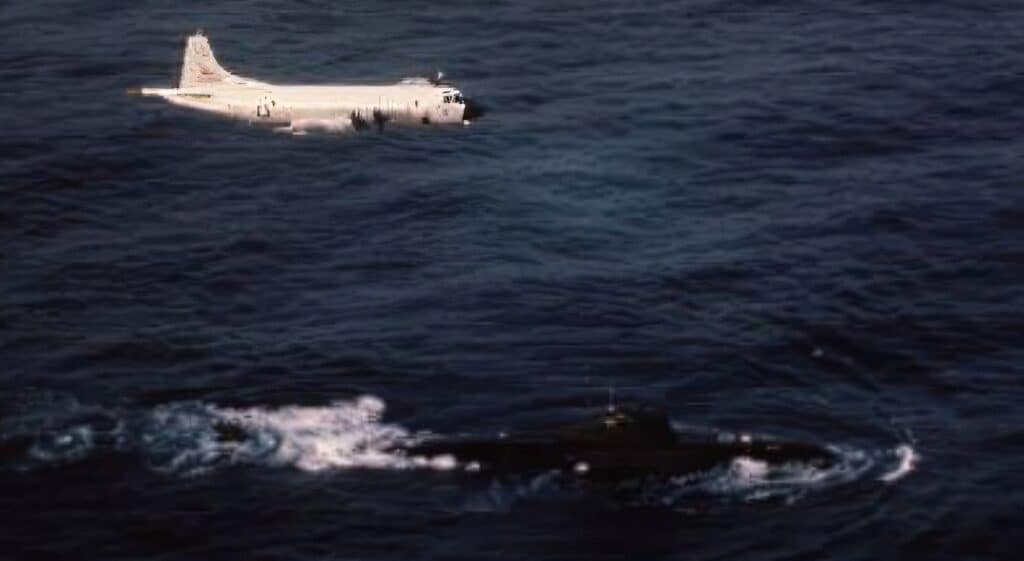
P-3 Orion deployed to Sicily to hunt for Russian subs in Mediterranean
As the ensign third pilot on the crew, I spent many flight hours on routine search flights keeping my eyes glued to a forward-looking infrared TV camera system, hoping to find surfaced submarines. These missions involved low-altitude, eleven-hour-track flights in the middle of the night, over water in our designated operations area.
This was far less exciting than I had anticipated.
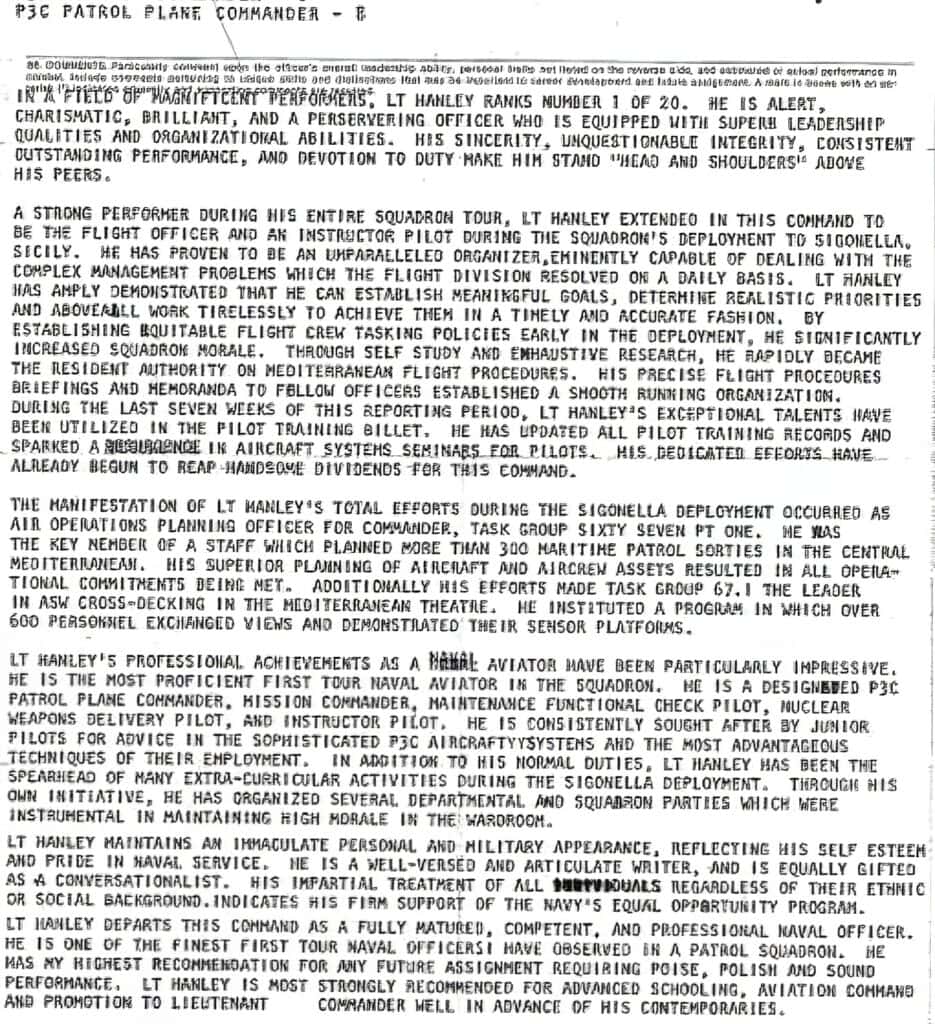
[Transcription for easier reading]
Review of LT Hanley by Commander Bob Howard:
In a field of magnificent performers, LT Hanley ranks number 1 of 20. He is alert, charismatic, brilliant, and a persevering officer who is equipped with superior leadership qualities and organizational abilities. His sincerity, unquestionable integrity, consistent outstanding performance, and devotion to duty make him stand "head and shoulders" above his peers.
A strong performer during his entire squadron tour, LI Hanley extended in this command to be the flight officer and an instructor pilot during the squadron's deployment to Sicily. He has proven to be an unparalleled organizer, eminently capable of dealing with the complex management problems which the flight division resolved on a daily basis. LT Hanley has amply demonstrated that he can establish meaningful goals, determine realistic priorities and above all work tirelessly to achieve them in a timely and accurate fashion. By establishing equitable flight crew tasking policies early in the deployment, he significantly increased squadron morale. Through self-study and exhaustive research, he rapidly became the resident authority on Mediterranean flight procedures. His precise flight procedures briefings and memoranda to fellow officers established a smooth-running organization. During the last seven weeks of this reporting period, LT Hanley's exceptional talents have been utilized in the pilot training billet. He has updated all pilot training records and sparked a resurgence in aircraft systems seminars for pilots. His dedicated efforts have already begun to reap handsome dividends for this command.
The manifestation of LT Hanley's total efforts during the SIGDNELLA deployment occurred as Air Operations Planning Officer for Commander, Task Group Sixty Seven Pt One. He was the key member of a staff which planned more than 300 maritime patrol sorties in the central Mediterranean. His superior planning of aircraft and aircrew assets resulted in all operational commitments being met. Additionally, his efforts made Task Group 67.1 the leader in ASW cross-decking in the Mediterranean Theatre. He instituted a program in which over 600 personnel exchanged views and demonstrated their sensor platforms.
LT Hanley's professional achievements as a Naval aviator have been particularly impressive. He is the most proficient first tour Naval aviator in the squadron. He is a designated P3C Patrol Plane Commander, Mission Commander, Maintenance Functional Check Pilot, Nuclear Weapons Delivery Pilot, and Instructor Pilot. He is consistently sought after by junior pilots for advice in the sophisticated P3C aircraft systems and the most advantageous techniques of their employment. In addition to his normal duties, LT Hanley has been the spearhead of many extra-curricular activities during the SIGDNELLA deployment. Through his own initiative, he has organized several departmental and squadron parties which were instrumental in maintaining high morale in the wardroom.
LT Hanley maintains an immaculate personal and military appearance, reflecting his self-esteem and pride in Naval service. He is a well-versed and articulate writer, and is equally gifted as a conversationalist. His impartial treatment of all individuals, regardless of their ethnic or social background, indicates his firm support of the Navy's Equal Opportunity Program. LT Hanley departs this Command as a fully matured, competent, and professional Naval Officer. He is one of the Finest First Tour Naval Officers I have observed in a Patrol Squadron. He has my highest recommendation for any future assignment requiring poise, polish and sound performance. LT Hanley is most strongly recommended for advanced schooling, aviation command and promotion to Lieutenant Commander well in advance of his contemporaries.
By contrast, aircraft carrier joint support operations were akin to joining a three-ring circus, overloaded with aircraft activity on multiple radio frequencies, all making it very easy to stub one’s toes. But we always succeeded in escaping the operating area unscathed, with our mission complete.
My plane commander, LCDR Ed Barrow, spent many additional instruction hours teaching me more about our aircraft that had not been covered in the classroom. Additional training flights were scheduled between operational flights to help me advance through the second pilot syllabus, which I successfully completed during this Mediterranean deployment.
When I returned to the States, I hounded the scheduling office to add my name to training flights to accelerate my progression through the Patrol Plane Commander syllabus. By staying focused and studying hard, I completed this in record time.
My squadron commanding officer was my instructor pilot during my plane commander check ride. I still vividly recall him briefing me concerning the pilot-in-command responsivities for crew comfort and the well-being of the fellow crewmembers on each operational flight.
To illustrate this point, he had me unstrap from the left seat once airborne and walk to the back of the aircraft, as he roughly banked the aircraft, pitched the nose up and down, and sent me reeling against the walls. After calling me back to the cockpit, he asked me how much I would have enjoyed the flight as an enlisted operator on a ten-hour mission in that rough environment. I was given similar treatment on return to the ramp at NAS Jacksonville through his intentional rough taxi, which included hard braking and jerky turns, to further amplify his point. “Just as in your ground job, always concern yourself with the comfort of your crew while airborne,” he told me before we deplaned. I let him know that I and my bruises had certainly absorbed the lesson.
Deployed to Iceland
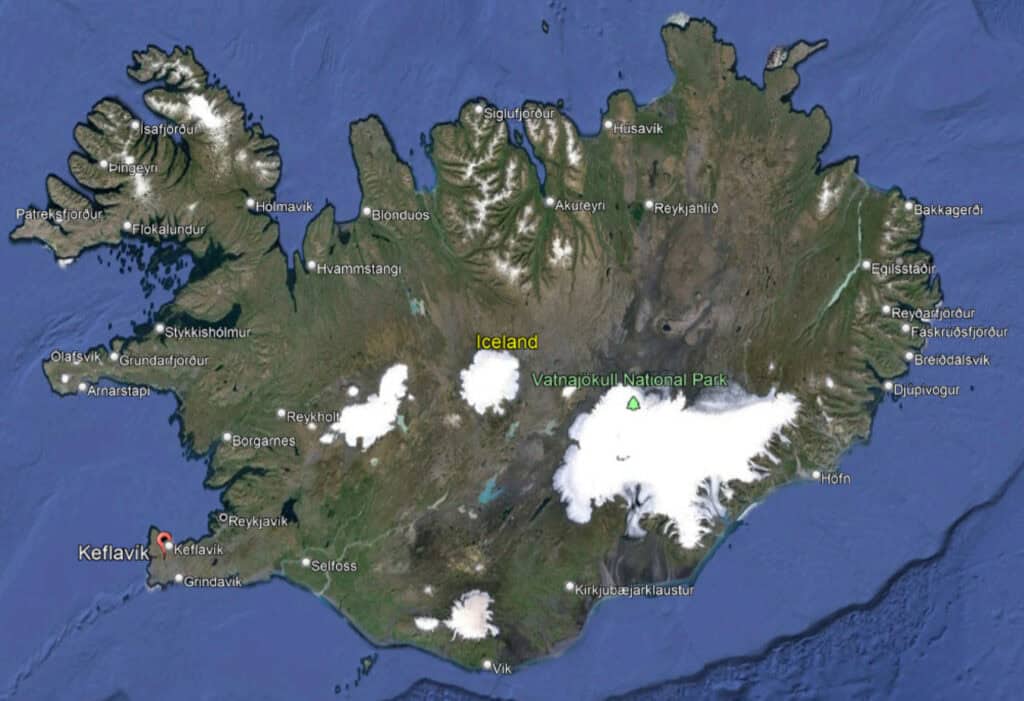
Deployed for 6 months to Keflavik, Iceland
I successfully qualified as Patrol Plane Commander in record time. The commanding officer then rewarded me by naming me plane commander as a Lieutenant Junior Grade (LTJG) on Combat Air Crew One for the next six-month deployment to Keflavik, Iceland. This was a great honor, since I then became the only Lt. (junior grade) crew-holding plane commander in the squadron.
While deployed in Iceland, flying nine-hour operational submarine hunting and reconnaissance flights, the pilot training officer gave me the opportunity to complete the instructor pilot syllabus concurrently, which I was fortunate to complete while in Iceland. As the only LTJG instructor pilot in the command, this gave me the opportunity to provide instructional training flights to junior pilots, thus simultaneously accruing additional flight hours above and beyond the normal operational flight commitments. These flight hours further enhanced my chances of later gaining airline pilot employment.
Several years prior, I had lamented the fact that insufficient tuition funds had stopped me from obtaining my civilian instructor pilot rating. But now I would be training military pilots on the sophisticated P-3 aircraft, which would enhance my airline resume if I chose to depart the Navy at the end of my service contract.
I was additionally qualified as a maintenance check pilot and also designated a P-3 Mission Commander, as well as a NATOPS (Naval Air Training and Operating Procedures Standardization) check pilot and nuclear weapons loading officer, all of which further enhanced my credentials for recommendation of accelerated promotion, should I elect to continue my Naval career.
“Never burn any bridges, but always keep your options open and your cards close to your chest.” I had been cautioned early on by more senior squadron officers with regard to my intended career plans concerning commercial aviation, while holding my options open for a Naval officer career. I was receptive to the suggestions of those intimately more familiar with Naval operations, and I followed their good advice.
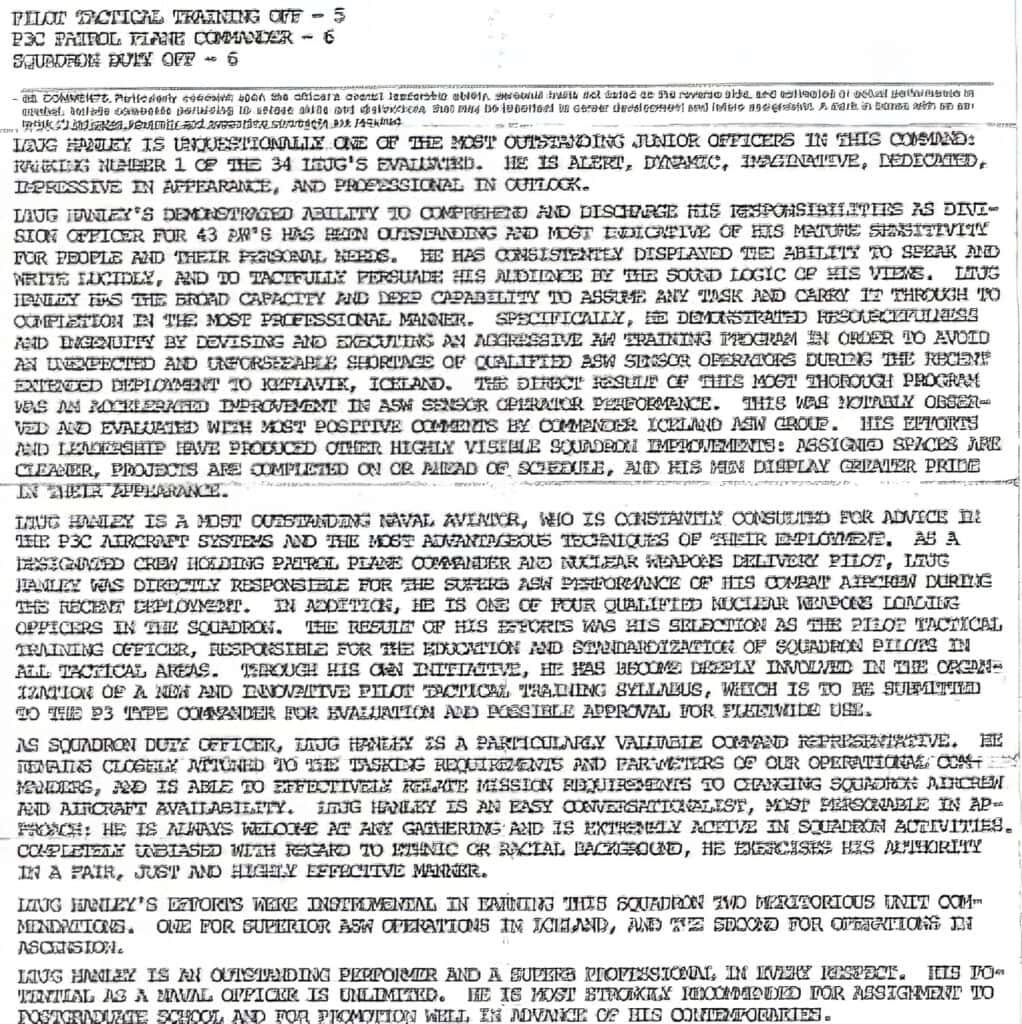
[Transcription for easier reading]
Review of LTJG Hanley by Commander Bill Bloh:
LTJG Hanley is unquestionably one of the most outstanding junior officers in this command: ranking number 1 of the 34 LTJG's evaluated. He is alert, dynamic, imaginative, dedicated, impressive in appearance, and professional in outlook.
LTJG Hanley's demonstrated ability to comprehend and discharge his responsibilities as division officer for 43 AWs has been outstanding and most indicative of his mature sensitivity for people and their personal needs. He has consistently displayed the ability to speak and write lucidly, and to tactfully persuade his audience by the sound logic of his views. LTJG Hanley has the broad capacity and deep capability to assume any task and carry it through to completion in the most professional manner. Specifically, he demonstrated resourcefulness and ingenuity by devising and executing an Aggressive Ground Training program in order to avoid an unexpected and unforeseeable shortage of qualified ASW sensor operators during the recent extended deployment to Keflavik, Iceland. The direct result of this most thorough program was an accelerated improvement in ASW sensor operator performance. This was notably observed and evaluated with most positive comments by Commander Iceland ASW Group. His efforts and leadership have produced other highly visible squadron improvements: assigned spaces are clearer, projects are completed on or ahead of schedule, and his men display greater pride in their appearance.
LTJG Hanley is a most outstanding Naval Aviator, who is constantly consulted for advice in the P3C aircraft systems and the most advantageous techniques of their employment. As a designated crew holding patrol plan commander and nuclear weapons delivery pilot, LTJG Hanley was directly responsible for the superb ASW performance of his combat aircrew during the recent deployment. In addition, he is one of four qualified Nuclear Weapons Loading Officers in the Squadron. The result of his efforts was his selection as the Pilot Tactical Training Officer, responsible for the education and standardization of squadron pilots in all tactical areas. Through his own initiative, he has become deeply involved in the organization of a new and innovative Pilot Tactical Training Syllabus, which is to be submitted to the P3 Type Commander for evaluation and possible approval for fleetwide use.
As Squadron Duty Officer, LTJG Hanley is a particularly valuable command representative. He remains closely attuned to the tasking requirements and parameters of our operational commanders, and is able to effectively relate mission requirements to changing squadron aircrew and aircraft availability. LTJG Hanley is an easy conversationalist, most personable in approach: he is always welcome at any gathering and is extremely active in squadron activities. Completely unbiased with regard to ethnic or racial background, he exercises his authority in a fair, just and highly effective manner.
LTJG Hanley's efforts were instrumental in earning this squadron two Meritorious Unit Commendations. One for Superior ASW Operations In Iceland, and the second for Operations In Ascension Island.
LTJG Hanley is an outstanding performer and a superb professional in every respect. His potential as a Naval Officer is unlimited. He is most strongly recommended for assignment to Postgraduate School and for promotion well in advance of his contemporaries.
Fork-In-The-Road Decision Time
Upon completion of their squadron tour, officers are required to submit duty preference cards to the Bureau of Personnel prior to receiving orders to their shore tour command. I had requested orders to Naval Post Graduate School in Monterey, California, to obtain a Master’s degree in Operations Research, since I had excelled in mathematics in college. As alternatives, I requested orders to one of the two P-3 Fleet Replacement Training Squadrons located in Jacksonville, Florida, and Moffett Field, California, for duty as an instructor pilot.

[Transcription for easier reading]
Dear Lieutenant (junior grade) Hanley,
You have been selected by the FY-78 Postgraduate Selection Board as a Tripple "X" (XXX) candidate. Triple "X" candidates are by definition alternates for various postgraduate technical (Engineering / Science) curricula for which they are eligible by virtue of designator and grade.
The criteria used for XXX selection were demonstrated professional performance and academic potential for a technical postgraduate program. The following groups were screened: (a) those officers in year group 69 and junior who did not indicate a postgraduate choice on their preference card or had marked it "do not desire", (b) those officers in year group 67 and junior who were not selected for a numbered curriculum of their choice.
It is requested that you indicate on the enclosed postcard, in order of preference, only those curricula for which you would accept orders, should they be tendered to you during your span of eligibility. The available curricula are: 360, 368, 382, 440, 525, 531, 535, 590, 591, 595, 600 and 611. A detailed description of these courses may be obtained from the Naval Postgraduate School catalogue for 1976-77 and the OPNAVNOTE 1520 of 23 April 1976. Whether or not you will be ordered to postgraduate school is based on your continued fine performance, your availability, your professional qualifications, career development and fiscal constraints - all of which are determined by your assignment officer. If you are nominated for orders to the postgraduate school and if your academic background is determined to be deficient in math and/or science, you will be ordered to the six-month Engineering Science curriculum (460) in preparation for your graduate level work. For your information, statistics show that 92% of all those officers ordered to this course have eventually completed their Masters degree work.
If you respond favorably to this Letter via the enclosed postcard, your eligibility for orders to postgraduate school will extend through fiscal year 1978. Additionally, you will be re-screened by the FY-79 Postgraduate Selection Board for the curricula choices you have indicated on your most recent preference card. I think it useful here to emphasize the act that your response to the enclosed postcard will in no way alter the curricula preference you have included on your preference card.
I knew that I would be receiving orders to my next command, but I also knew that I was within the narrow window of opportunity to submit my resignation from the Navy.
Upon my return from Iceland, I was scheduled to receive orders to my next command prior to the Fall deployment to Sicily. But I convinced my commanding officer to request an extension of my current orders. That way, I could join the squadron on deployment to train new pilot instructors, since many of the existing instructors would be detaching from the squadron upon return to the States. With the Skipper having friends in the Bureau of Personnel, the requested extension only involved a phone call to Washington and it was approved.
Reviewing my time in the Navy, I had good reasons to be proud of my achievements. I had managed over the course of the past three years in the squadron to achieve near-straight “A” report card grades, and I was ranked in the top one percent of my officer peer group on all my fitness reports while being recommended for accelerated promotion on all but one report. I had worked very hard and played hard. Privately, I prided myself that I had never back-stabbed another officer, nor kissed a single butt during my entire squadron tour, as I had observed so many other junior officers do quite often in an effort to “excel.”
My orders were received to report to the Naval Post Graduate School in Monterey to study Operations Research upon completion of the Sicily deployment, with an added appointment to the Navy Weapon Acquisition Management Program (WSAM) because of my “good report card grades” — which would most probably mean a Pentagon tour upon completion of school and an end to my Naval flying days. These were dream orders for a career Naval officer. But, for me…?
Decision time! I stood at one of those critical junctures in life that we all face. But I knew two things — that I wanted to fly airplanes as a career, and that I had always had my sights set on the left seat of a commercial jet airliner as my end game.