5. Naval Propeller Flight Training
It takes someone with a vision of the possibilities to
attain new levels of experience. Someone with the
courage to live his dreams.
—Les Brown
Now the sweat is pouring down your back as you wield the stick, flying a T-34 turboprop trainer with the hot Florida sunshine glaring through the canopy. Suddenly, the intercom crackles with the threats of the screaming instructor sitting behind you.
“Two-six-ten!”
“Sir?” You’ve just realized he’s told you, in Navy slang, that it’s going to take “two surgeons six hours to remove ten inches of his boot from your ass.”
Something sharp prods you in the back of your neck, right at the base of your skull.
“Delta Sierra, report! Or do I have to stick this knife in and cut it out of you?!”
Okay, now he’s just called you a “dumb shit” and threatened your life, but as you think about it for a second, you understand he only wants the “time, position, and fuel” report.

T-34 turboprop trainer
You quickly and loudly announce the numbers from your gauges, hoping he doesn’t assign you a “Down.” If you accrue three “Downs,” you’ll find you have been escorted permanently off your career path toward being a pilot.
I was fortunate to rarely have to accommodate the “screamers” as co-pilots during my training time in T-34s and T-28s. But they sure could keep you on your toes.
Naval propeller flight training consisted of four stages:
- Primary Prop Training
- Basic Flight Training
- Advanced Flight Training
- Replacement Air Group Training
Primary Prop Flight Training
Reporting for T-34 “primary prop flight training” proved very exciting! We were issued our flight suit, helmet, life vest, boots, a knee board for writing notes, and the traditional brown leather jacket. The T-34 aircraft is a tandem seat, two-pilot airplane with the instructor occupying the rear seat and communications conducted over the intercom system.
My primary instructor was a Marine Viet Nam veteran A-4 pilot named Captain Roller, who, unlike some of the other instructors, proved not to be a “screamer.”
All training flights were preceded by a briefing to ensure each student was thoroughly familiar with the conduct of that day’s flight. As a student pilot you paid attention to every syllable because you couldn’t afford to be awarded the dreaded “Downs” on your instructors’ reports.
Flight training was extremely regimented. Each procedure for every phase of flight was detailed in text book format that you were expected to have thoroughly memorized before each flight. Woe be to the student who failed to adequately prepare for a flight! In such cases, instructors would often scream countless unsettling obscenities over the intercom, or unstrap from their seat in flight, climb up behind their student pilot, and repeatedly whack them on the helmet with their kneeboard.
Consistently poor performance guaranteed a negative reputation amongst instructor pilots. When this occurred, it was the “kiss of death” for that student’s aviation career. The Navy was spending millions to train pilots, and the poor performers were weeded out early in training. Knowing this made primary flight training a real pressure cooker for us. Because of the vast difference in training methods, as compared to my civilian training, I usually felt that I was barely hanging on by my fingernails. Yet, there was always hope, because I had never been whacked on the head, nor screamed at by my instructor. Instead, I found myself earning very high grades on my flights, which was a relief and at the same time another confidence-booster, though I understood very well the importance of not getting cocky about it.
I continued to study very diligently until I passed all ground instruction tests and instructional flights with high marks. In fact, I stayed so busy studying that I was surprised to learn that I had the top grades in my class upon graduation from primary flight training. I felt that the added advantage of my prior flight training in junior college had obviously made a difference.
Although the conflict in Southeast Asia was winding down by this time, the Navy was making a major push to encourage students to choose the jet fighter training pipeline, rather than helicopter or prop training. The selection process for each was determined purely by the student’s flight grade standing in his class. Since my “end game” was to depart the Navy after six years to pursue an airline pilot career, I chose the prop plane pipeline, because I was fully aware of the mission of the four engine P-3 Orion patrol plane. I made that mission my aim this early in my training. My decision was based on the fact that this aircraft flew very long missions, enabling the accrual of many flight hours — plus, it did not involve six-month cruises on those big grey boats known as “aircraft carriers.”
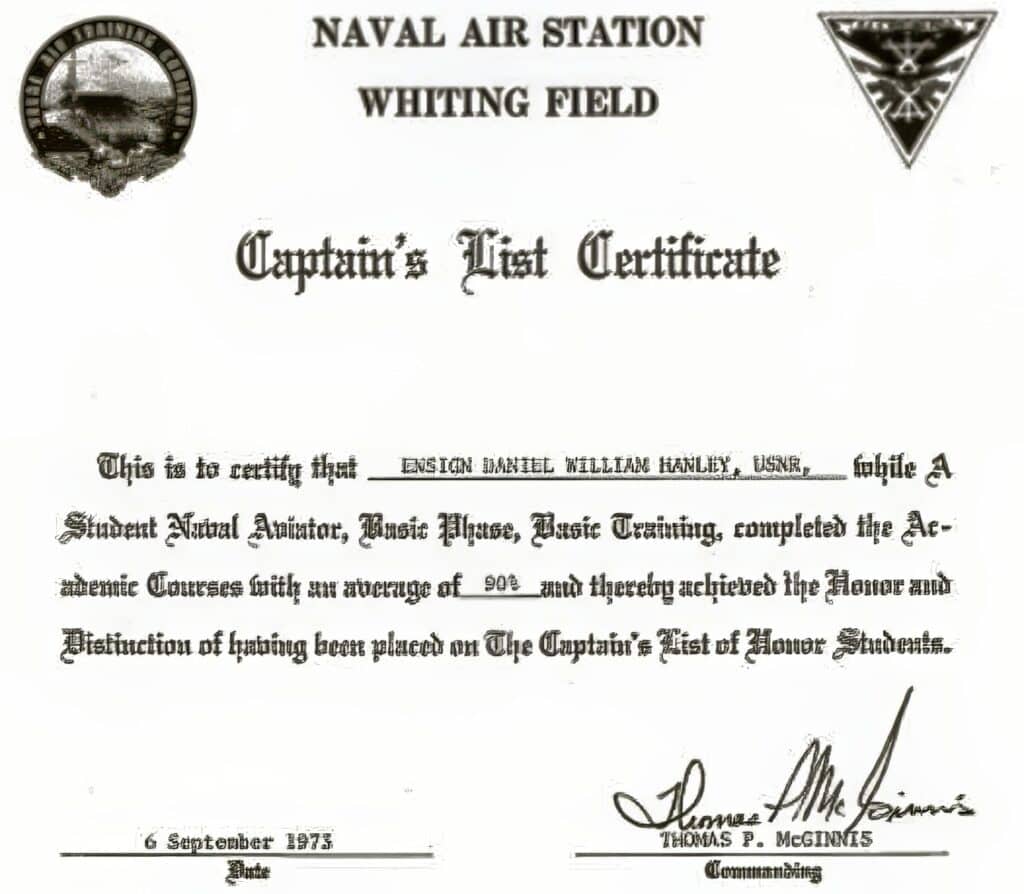
The Captain’s List of Honor Students with 90% Academic Achievement
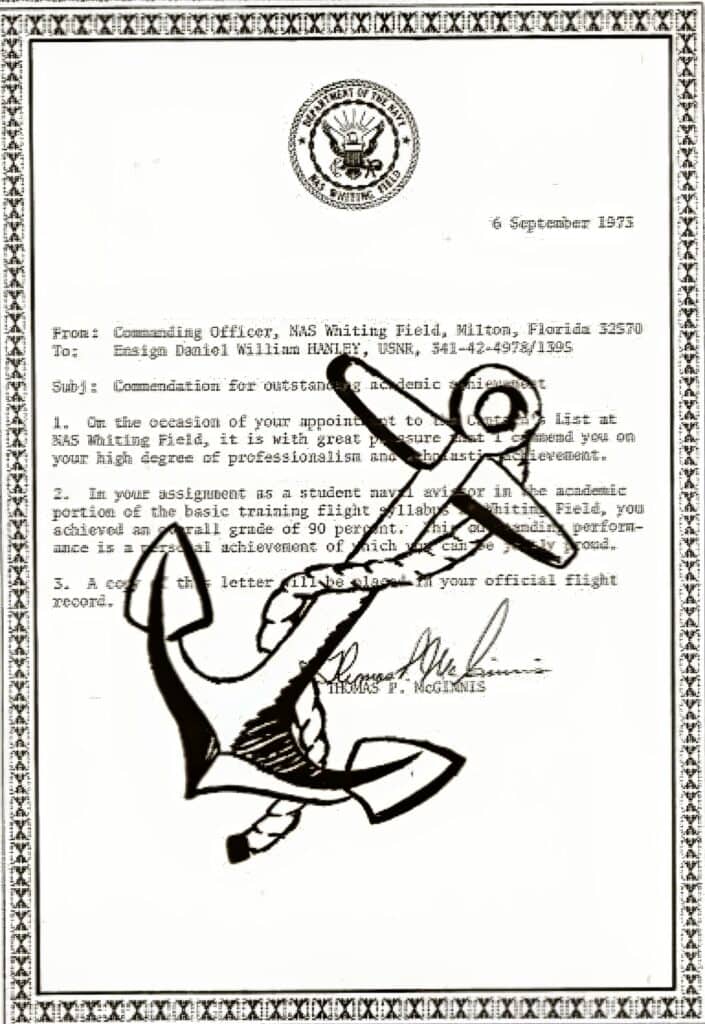
Commendation for outstanding academic achievement 6 Sep 1973
Basic Prop Training

T-28 Trojan basic prop trainer with massive R-1820 radial engine
The T-28 Trojan used for Basic Prop Training, unlike the T-34, was powered by a massive R-1820 radial engine. This engine provided so much torque with a sudden application of power in flight that it could almost send the fuselage of the aircraft wrapped like foil around the engine. My instructor, Lieutenant Dick Borth, a very likeable and professional gent, informed me that although the procedures for operation were similar to my T-34 training, the aircraft accelerated much faster with greater power, requiring the student to think faster, which was later to prove a mild understatement of fact.
This phase of training included basic maneuvers, night flying, instrument flight training, acrobatics, formation flying, and cross-country navigation. After surviving basic maneuvers training with Lt. Borth, we each were trained in subsequent syllabi by various instructors. Once in a while, this would include one of those “screamers.” In fact, one of those occasions was what I described as I opened this chapter. Still, I received no “Downs,” and no whacks across the head.
The training was fast-paced and rigorous. While many of my fellow aviators enjoyed their evenings at the Officer Club bar, drinking with their instructors instead of studying, I was determined to excel and, once again, “burned the midnight oil” preparing for each flight. I felt that there would be plenty of time for partying once I reached my fleet squadron.
Yet again, I was very much surprised when I was honored with the distinction of being named “Student of the Week” amongst the 228 trainees during my graduation from Basic Prop Training to the next phase, Advanced Prop Training at NAS Corpus Christi, Texas in the TS-2A Tracker aircraft.
The hard work had paid off, and my perception had proved correct. I was very much humbled, awe-struck, and honored by this distinguishing award.
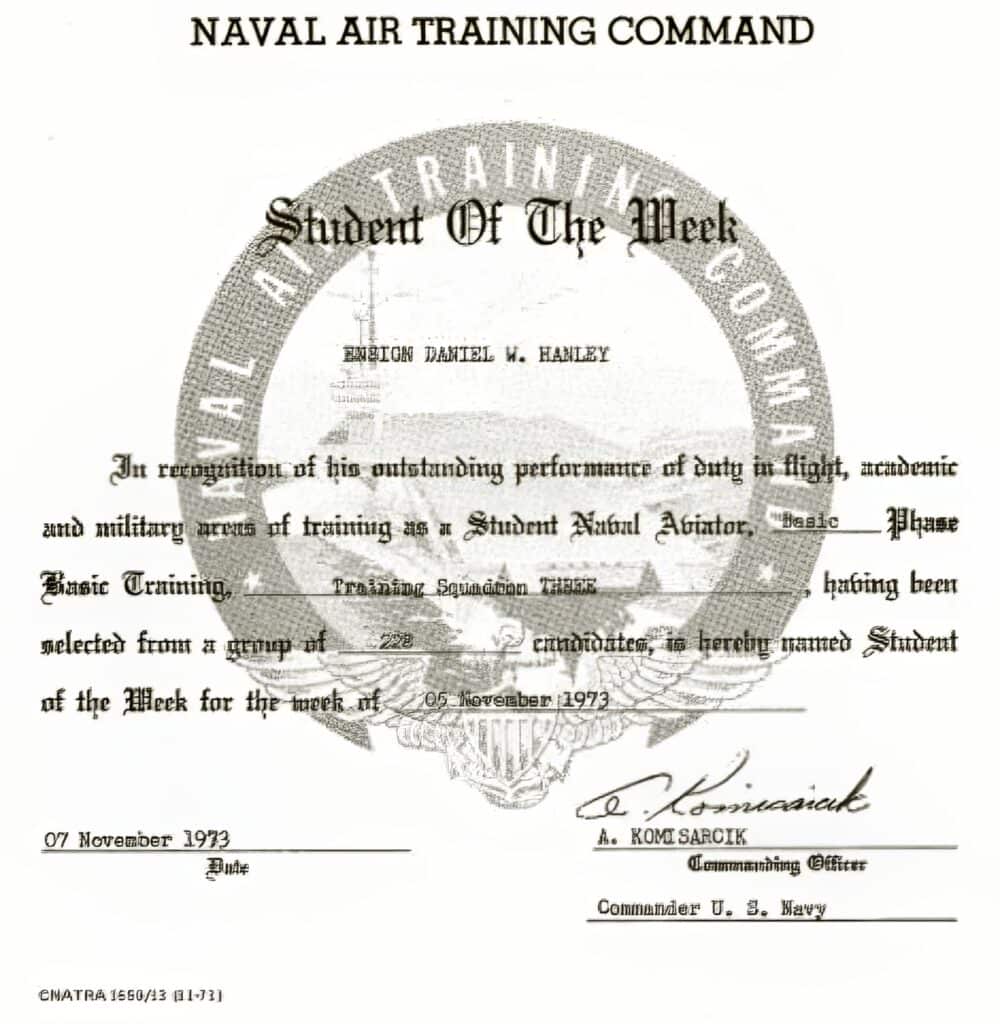
Basic Prop Training Student of the Week outstanding performance
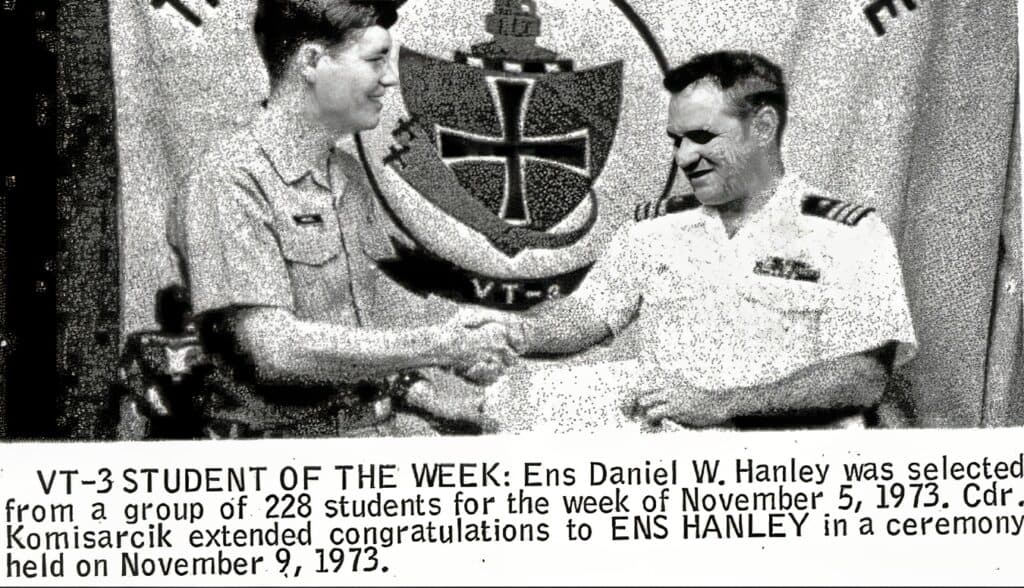
Daniel Hanley was congratulated by Cdr Komisarcik as Student of the Week
Advanced Prop Training
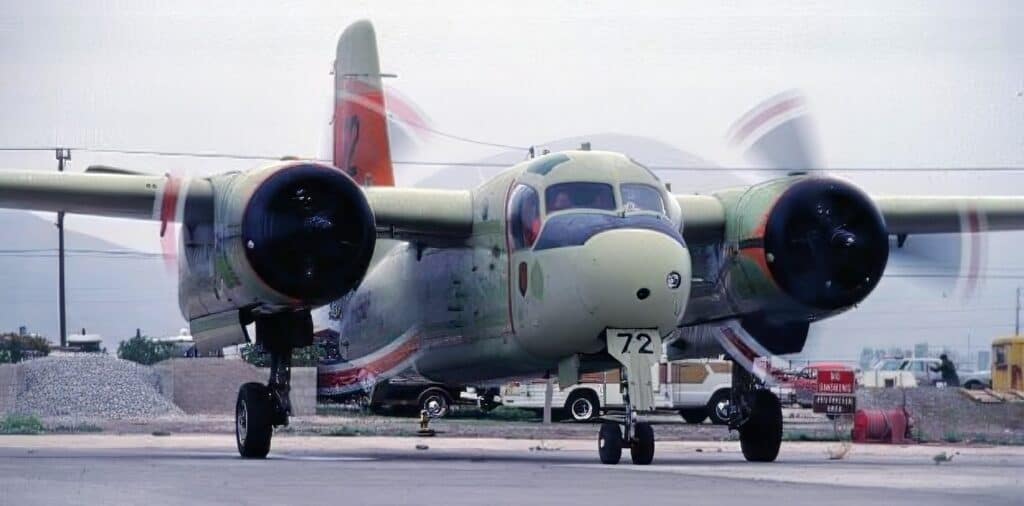
TS-2A Tracker turboprop trainer with two R-1820 radial engines
My arrival in late 1973 at “the Sparkling City by the Sea,” Corpus Christi, proved a welcome relief in many ways. We had all proven our worth as Naval aviators in earlier training phases. Successful completion of this phase of training would now guarantee us our cherished Navy Wings of Gold.
The TS-2A Tracker was a relatively antique, high-winged, twin-engine turboprop aircraft with side-by-side seating, configured with two R-1820 radial engines that were previously employed in the fleet and catapult-launched from aircraft carriers for close-in enemy submarine tracking operations around the world. The wings of the aircraft folded upward hydraulically for storage on aircraft carriers, which often proved troublesome for maintenance.
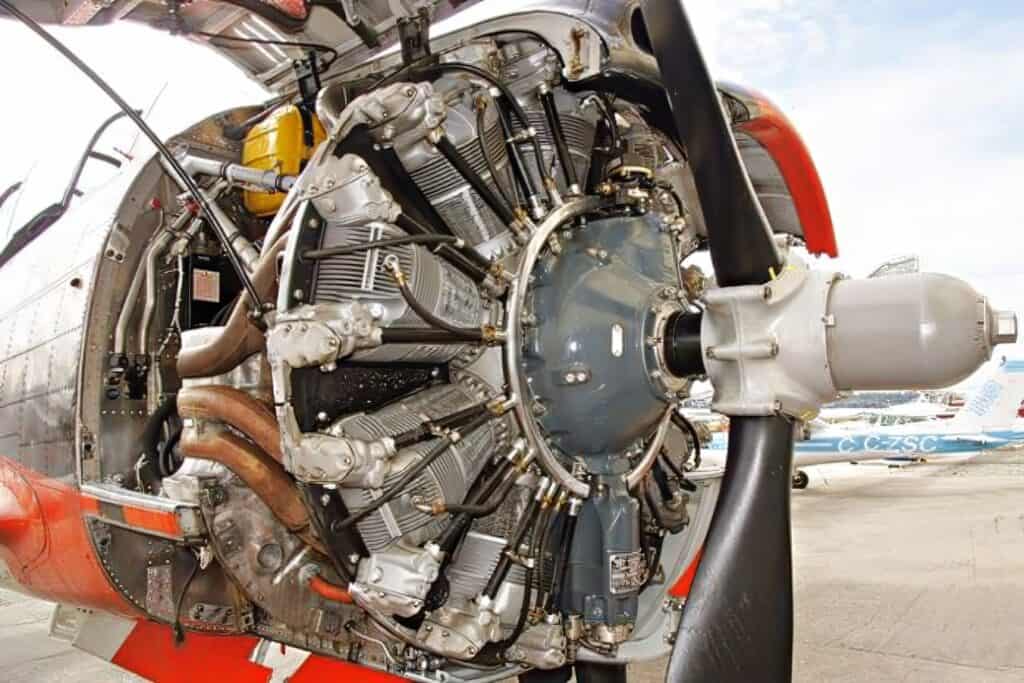
T-1820 turboprop radial engine on the TS-2A Tracker
Advanced multi-engine prop training for fleet operational aircraft placed the emphasis on engine failure and cross-country procedures, including countless touch-and-go landings at various airfields surrounding the Naval air station and beyond.
Fortunately for me, my instructor, Lieutenant Bob Schmidt, had previously flown P-3 Orion aircraft in the fleet and had returned to his shore duty to serve as an instructor. The wisdom imparted in not only my TS-2A Tracker training, but in fleet orientation, proved invaluable to me. In contrast to our many long hours flying T-34’s and T-28’s, suffering high pressure and even threats along with the broiling heat of the sun, we were treated with dignity and respect in a much more relaxed training atmosphere.
As with previous training command future pipeline assignments, rewards were given to top-level performers in first choice not only for their fleet assignment aircraft but also for their air station location. In reviewing the deployment locations of the P-3 squadrons based at NAS Barbers Point in Hawaii; NAS Moffett Field in California; NAS Brunswick in Maine; and NAS Jacksonville in Florida, I selected NAS Jacksonville as my “target of opportunity” and set out to achieve high flight grades in this latest and very competitive phase of training.
Compared to the previous training syllabi, advanced prop training seemed simple. But I continued to intensely study procedures and systems, which once again paid dividends in the end.
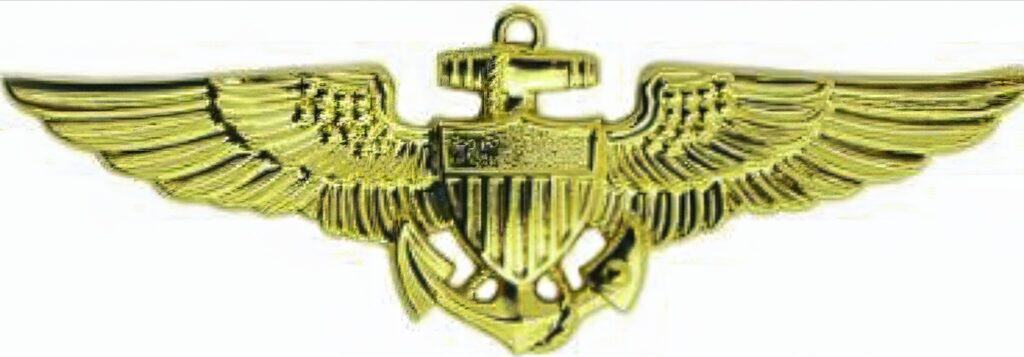
Navy Wings of Gold
In April, 1974, I was designated “Student of the Month,” with the highest grades in my graduating class as we donned our white choker uniforms, our Navy Wings of Gold finally emblazoned across our chests as we left the graduation ceremony in the hangar spaces. Once again, dumbfounded and humbled by this distinction, while realizing that hard work does pay off, I vowed to myself not to rest on my laurels, but to work doubly hard in P-3 training, as well as in my fleet squadron, not to compete with others, but to work hard and play hard as a Naval aviator. Self-efficacious confidence in myself was building, but I always remembered the adage:
“There are old pilots and there are bold pilots, but there are very few old, bold pilots.”
Safety, in aviation, is paramount.
I was now a Naval Aviator, with assigned orders to report for duty to Patrol Squadron Forty-Nine, home-based out of Naval Air Station in Jacksonville, Florida.
P-3 Orion Replacement Air Group
Before reporting to their assigned P-3 Orion fleet squadron, each aviator was required to receive basic training in the squadron aircraft at either NAS Moffett Field or NAS Patuxent River, depending on which coast your squadron was based. I was assigned to the Naval Air Station at Patuxent River, Maryland, for completion of the P-3 Replacement Air Group training.
Arriving in the late spring of 1974 and attending basic anti-submarine ground training, in addition to training in this four-engine advanced aircraft with a 135,000-lb. max gross takeoff weight was, for me, akin to working towards a Ph.D. in Naval Aviation. This aircraft had multiple fleet missions beyond hunting and tracking Russian submarines. It was also employed for reconnaissance, search and rescue, mining, missile launching, and many other missions. With a crew of five officers, which consisted of three pilots and two Naval flight officers, and an enlisted crew of seven personnel with varied responsibilities, this aircraft was designed to fly any of these missions to all points on the globe to which it was dispatched.
We spent many hours training for various landing patterns, learning to master normal landings, simulated engine-out landings, and other irregular procedures.
Flying an overwater navigation flight that terminated in Nova Scotia was my first excursion in an aircraft outside the United States and I felt that I had finally graduated to the big leagues. It didn’t enter my mind at the time that this was only the first of many such departures abroad to distant and exotic locations in my flying career.
Being a very humble aviator, I must admit that my hard work paid off once again, as I also graduated top of my class in this training. Now it was on to my fleet squadron, imagining that I was on top of the world.
But, upon reporting to my commanding officer in Jacksonville, I landed with a thud on the sobering realization that I was now on the bottom of the seniority totem pole, merely a Junior Ensign and an undesignated P-3 Orion pilot with zero fleet experience. This reality was most humbling.
Despite that feeling of the moment, I was on my way to a life as a “chosen one,” as my usual dogged persistence would prove eternally rewarding. On the brink of reaching a pinnacle coveted by many with just one additional step — I would eventually turn my back on that summit and descend for another course.