2. Dancing on the Clouds in a Cessna 150
We don't know who we are until we see what we can do.
—Martha Grimes
It was September 1968 and I was only 19 years old. “You’ve got the aircraft.”
The voice was that of Ed Shafer, my private pilot instructor, at Downtown Airpark in Collinsville, Illinois, on the occasion of my first excursion above the planet earth to “dance on the clouds” in a single-engine Cessna 150.
“But I’ve never flown in an airplane before!” I screeched. “And I’m already the pilot?!”
Ed chuckled, beamed me a big smile and backed me up on the controls.
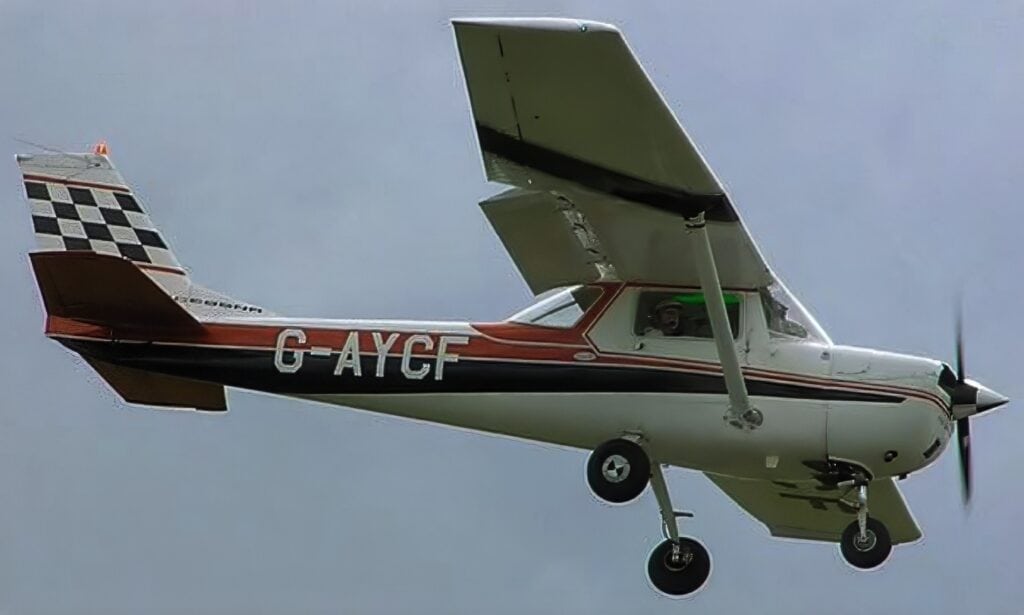
Dan trained in the Cessna 150 for his private pilot license
As many of my high school friends flew off to engage in the carnage in Viet Nam, other students from affluent families enrolled in colleges across the land. With only my own limited funds available, I applied to the low-cost Belleville Junior College (later to be known as Belleville Area College), then registered for general studies courses, which afforded me a student deferment from the U.S. Army Selective Service system — the military draft. Mathematics being my educational Achilles’ heel, I wincingly registered for the required “Basic Math 101” course, praying that I might achieve a “C” grade to retain my deferment.
The Belleville Junior College didn’t have its own campus in those days. It used classrooms in one of the local high schools.
During my freshman year, I undertook an ever-expanding search for tuition monies and an affordable civilian aviation flight training school. Parks Air College in Cahokia, Illinois, a branch of St. Louis University, required enrollment in one of their technical degree programs for participation in their flying program, as did the University of Illinois. Alas, tuition costs at these universities far exceeded my puny budget.
Frustrated but determined, I set out on a course to obtain funding through the Illinois Guarantee Student Loan Program. It was during this time frame, by a seemingly miraculous coincidence, that Belleville Junior College announced a very affordable two-year Associates Degree Program in Aviation Technology, completion of which would enable students to obtain their Private, Commercial, Instrument, Multi-engine, and Instructor licenses over just a two-year period. This was an exciting discovery, though it brought its own challenges. But I surmised that if I worked full-time while attending school with the aid of these loans, it would provide me with the resources to complete the two-year degree program and acquire my pilot licenses and ratings.
Oh, and I did achieve a grade of “C” in Basic Math 101.
With good credit, my dad agreed to cosign for a series of student loans for tuition and enrollment in the Aviation Technology Program, commencing in my sophomore year. With renewed hope and optimism for a piloting career, I became emboldened and enrolled in College Algebra the second semester, along with the prerequisite courses for the aviation curriculum. Life then became a matter of burning the midnight oil, studying frantically — lots of work, little discretionary spending and little sleep. But, with the assistance of my math teacher, who lived next door and agreed to tutor me in the evenings, I achieved an “A” in algebra, which strengthened my confidence that perhaps, with this same kind of intense, diligent effort which had just paid off with that grade, coupled with my own God-given talents and intelligence, I could achieve anything I set my mind to do.
In the fall of 1968, I registered for my aviation courses, along with other general studies courses in the curriculum. A few weeks later, I met with Ed Shafer at Downtown Airpark in Collinsville, Illinois, for my first private flight instruction, an excursion above the planet earth in that Cessna 150 that seated all of two passengers.
I still recall, as we approached this small aircraft sitting on the ramp, Ed remarking to me, “Your preflight safety checks begin as you walk up to the plane.” He noted that many discrepancies could be noticed from afar, but might not be detected up close, a phenomenon akin to an artist standing too close to a painting-in-progress to take in its full effect. Under Ed’s sage tutelage, aviation safety was ingrained in my soul as a pilot from that first day forward in my career.
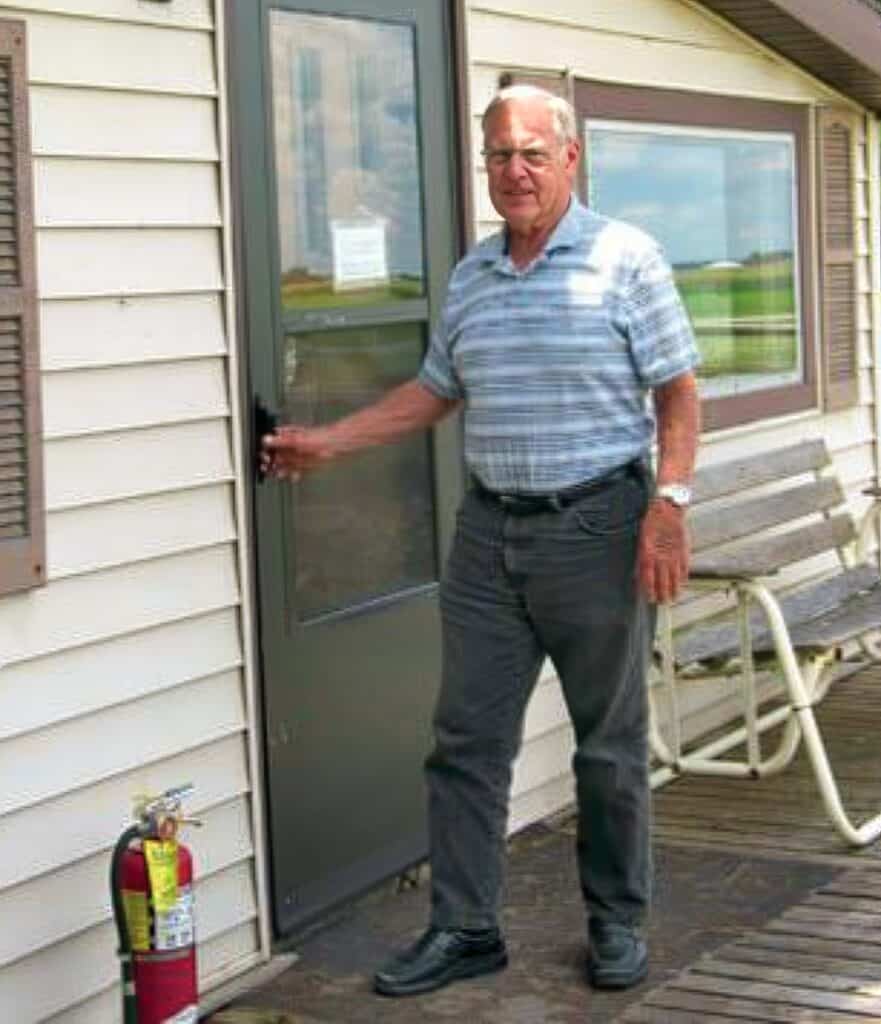
Ed Shafer was Dan’s flight instructor for his private pilot license
Never having flown in an aircraft in my life, we started the small Continental engine, and Ed taxied us out from the right seat to the run-up area to perform routine carburetor heat, magneto, and mixture checks on the engine. Once the aircraft was aligned on the centerline of the small asphalt runway, Ed pushed the throttle to maximum power as he released the brakes and then spoke those stunning words, “You’ve got the aircraft,” as we rolled down the runway for takeoff.
As we lifted off the runway, lumbering into the air, my panic segued into overwhelming exhilaration, my pounding heart beating at a volume I swear I could hear above the engine noise. The little boy who had played “captain” many times in his basement, the same little guy who used to jump off his dad’s garage roof, was actually flying a real airplane! This was only my first “baby step” in aviation, with a long road ahead to reach the captain’s left seat of a commercial jet airliner, but it was definitely a step in the right direction — upward.
Because I was working full-time at odd jobs to pay for my education, I studied diligently whenever I could, and thus remained very well prepared for each ground school examination and flight. As with every private pilot student, I learned the basics of stall recovery, slow flight, turns about a point on the ground, steep turns, and landings that included short field and soft field techniques that proved invaluable in my later years of flying. Through unrelenting efforts, I achieved straight “A” grades in my courses throughout the two-year aviation curriculum.
On October 31, 1968 — Halloween — I was scheduled for an evening flight with my instructor, Ed Shafer. I had invited my dad to join me at the airport to observe my touch-and-go landings in the Cessna 150, with Ed providing dual instruction from the right seat. At that time, I only had around eight hours of dual instruction and a handful of landings. At twilight we lifted off, with my dad proudly looking on from the ramp as our small aircraft climbed to pattern altitude and returned to ultimately make two perfect landings. Ed then took control of the airplane from me and taxied to the ramp near my dad. Climbing out, he told me. “Okay, this is it. Time to solo. Show us two more landings just like those last two.”
This launched me into some deep breathing exercises, after which I was partially able to catch my breath and slow my heart rate before explaining, “Ed. I don’t feel quite ready to crash an airplane right in front of my dad. Can I have a few more hours, first?”
“You’ll do fine,” Ed grinningly assured me, as he hopped out of the right seat and slammed the door behind him. So, this was “it.” After a little more controlled breathing, I taxied out once again to the run-up area. Along the way, I contemplated saying a rosary, or at least a few “Hail Mary’s” and “Our Father’s” before flight. But then, I felt a mingled sense of peace and excitement as I gained the nerve to take flight, alone, for the first time. So… up, up, and away.
Upon each of my two returns to earth, once below 100 feet, I found myself adding an extra “procedure” to those Ed had taught me, namely, holding my breath and gritting my teeth as I approached the hard earth at high speed. But my solo landings ended up being quite smooth as well, marking one more step down the road of increasing self-confidence that I could actually handle the course I had set for myself.
All smiles, Ed and my dad congratulated me on my survival. I rushed home to call and update many friends and relatives on this milestone event. Then, I dashed across the street to pay a visit to Woody Woodrow and share the tale of my first solo pilot experience. I remember thinking that I had arrived; I was a pilot. Little did I realize how wet my frisky puppy dog ears must have appeared to everyone — first of all to Woody; I still remember his broad, tight smile before he finally nodded and said, “All right, kid. All right.”
A few weeks later, I would receive a very sobering reminder of reality as I read a memoir by aviation author Ernie Gann entitled, Fate is the Hunter.
A combination of solo and dual instructional flights followed for several weeks into that Fall as I continued to accrue the 35 flight hours required by the Federal Aviation Administration to apply for the check ride that I had to perform to qualify for my private pilot license. During this period, ofttimes Ed would pull the power back on the single throttle at altitude and advise me to simulate engine failure. In a single engine aircraft, when the engine fails, the pilot then becomes a glider pilot, which requires a search for an empty, flat field to glide the aircraft toward for the sake of making a soft field landing.
Once I had the aircraft safely configured, approaching touchdown on the farmer’s field I had chosen, Ed would apply power and have me climb back to altitude. There were a few times when I misjudged my glide ratio and arrived high at my destination field, only to watch it pass under me and to realize I was destined to take down the fence at the property line and very likely flip the airplane into a full-on crash, had I actually lost an engine. This was a sobering prospect, to say the least, and an incentive to get it right the first time. There is no room for being sloppy in a cockpit.
One sunny afternoon, as I walked towards my aircraft for a solo flight, I was approached by an older gent who introduced himself as Dick Nadig, while asking if he might provide me with dual instruction, free of charge. Dick was a Major in the Air Force and a pilot who had just returned from duty in Viet Nam. As we made our introductory chat, Dick informed me he was working towards his instructor rating, the reason for his offer.
I was very excited to be soloing that day, so it was with some reluctance that I agreed to his offer. Yet, it turned out that meeting Dick saved my life that very day. Fate was, indeed, “the hunter” that day, but Fate also seemed to have arranged for Dick to be assigned as my guardian angel, making this a “double or nothing” day for Fate!
After completion of our preflight and engine run-up, we were airborne together and flying north to our routine practice area. As I climbed toward 3,000 feet, our level-off altitude, the entire aircraft suddenly began shuddering so wildly that the dials of the instrument panel before me seemed like a blur, my eyeballs rattling in my head as I frantically attempted to discern the cause. Without hesitation, Dick told me that he had control of the aircraft, and took the yoke from me.
In a second, Dick pulled the mixture knob to full lean, which basically shuts the engine down, leaving the propeller still wind milling at the nose. Pulling the nose of the aircraft up, he stalled out the propeller, thus bringing the propeller and engine to a full stop.
Amidst ominous silence, save for the noise of the wind stream outside the aircraft, Dick instructed me to look out my side of the windscreen to see if part of the propeller had broken off.
To my horror, I stared at a prop with 3 inches of the tip missing — it had broken off!
“Okay, there’s no way I’m restarting the engine, then,” Dick calmly explained. “Help me find an open field.”
I immediately pointed out Fostaire Field, an abandoned and overgrown grass landing strip, off the left-hand side of the plane. Rolling into a left bank so that he could assess the field condition, he handed me the microphone and suggested that I contact Downtown Airpark on the radio and advise them that we needed a cab to pick us up after our landing. I actually thought he was joking with me, although I attempted to comply, meanwhile trying to pull my thumping heart from my throat and stumble through the radio transmission as he had ordered.
I did make contact and put the message across. But, after a very long pause on the other end of the radio, the voice of an obviously bewildered woman responded, “Say again?” Dick grabbed the microphone from me.
“We have just shut our engine down and we are landing at Fostaire Field, but we are a little bit busy asking that you kindly send a taxi cab to our location,” he barked, tersely.
I was flabbergasted as we continued our power-off glide through 2,000 feet of descent as Dick continued with his flight instruction dialogue for my benefit as the pupil. He advised me that if I ever had the engine lose power on a solo flight, to make sure that the fuel lever was on, the fuel mixture was set to rich, the carburetor heat was off, and various other safety checks.
Astonished, and imagining my entire life passing before my eyes as we continued our glide on a base leg to final approach to the field, I almost screeched in panic, but instead managed to say, “Please explain these procedures once we land safely in the field, okay?”
Dick actually chuckled, which cleared my mind enough to realize that this type of thing was apparently routine experience for him, and most probably child’s play compared to the air action he had experienced in Viet Nam.
Rolling on final approach to the field, Dick noted power lines on the approach path and advised me that he was going to bring the aircraft in at a high altitude, clear the power lines, and then “side slip” the aircraft, inducing a rapid loss of altitude, while commencing to break his descent rate at around 100 feet, pulling up the nose of the plane in a flare for landing.
We both realized a bit too late that the field was sloppy wet with standing water in the very tall grass. Before I could experience a fresh wave of panic, he quickly explained, “Okay, I’m gonna try to hold the nose wheel off the ground as long as possible.” Through my sensation of panic, I realized he meant, lest it dig into the mud, which would send us cartwheeling down the field in a crumpled mass of metal.
With phenomenal precision due to his wealth of flying experience, Dick planted the main gear near the end of the field and we both pulled back on the yoke, but we had only traveled around 100 feet across the field when the nose wheel did dig in, splattering weeds and mud all over the windscreen. But that was the extent of it. Shutting off the ignition once we were at a standstill, we both heaved a sigh of relief and stepped out into the swamp in which we had landed.
We then to observed several aircraft overhead buzz the field. Our distress call for a cab on the radio had been broadcast all over the greater St. Louis metropolitan area. Aside from our own fresh trauma, I feared that we would momentarily observe a mid-air collision as the number of aerial sightseers circling the field increased.
While we waited for our cab, each lost in our own silent thoughts, I reflected on the fact that I had intended to fly solo that day.
“Dick?”
“Yeah?”
“What might have happened if you had not shut that engine down?”
“Within a minute, the engine would have separated from the aircraft,” he explained. He needed say no more. I knew he meant we would have fallen to earth like a leaf, but gone “splat” at the end.
He went on to explain that, with only four bolts holding the engine frame to the firewall, had he not ceased engine/propeller rotation, the intensity of the vibrations would have made that separation and resulting loss of control inevitable — and fatal.
What we both knew went unspoken — that with my inexperience, I would not have recognized what was occurring, nor have known to shut the engine down.
“Fate is the Hunter.” I saw clearly why that was such an apt title for Ernie Gann’s book, and it applied just as much to the experiences of modern-day pilots as it had to his subjects in the early days of aviation history.
Ed Shafer had taught me to check the condition of the propeller on my preflight walk-around for nicks, scratches, dents, warps, and the like. The back of the propeller is coated with a black paint for this very reason. Hairline cracks are difficult to discern otherwise, and with the safety of my own hide foremost in my mind, I would subsequently very carefully inspect the back of the prop, each and every time before going airborne.
There was a tragedy in the ranks within the next two months, when it was determined that another student pilot returning from a night solo cross-country flight from Decatur, Illinois, had inadvertently flown into a cloud bank while not yet trained to fly by reference only to his instruments. He had subsequently spun his airplane in from altitude, killing him and leaving the recovered aircraft a crumpled mass of metal. Several student pilots suddenly recognized the inherent dangers of student flying programs, and dropped out of flight training to pursue other career goals.
As for me, my semester ended with straight “A’s” in my aviation courses and my private pilot license and Diploma in hand.
Many years later I learned that Edward B. “Ed” Shafer had been inducted into the Illinois Aviation Hall of Fame. His wife became a corporate pilot. They purchased a dairy farm in 1969 and built a restricted landing area in their backyard. In 1975, the airport was upgraded to a public use airport and the dairy farm was replaced by hangars and airport buildings. Shafer Field trained more than 500 pilots. Ed became a Designated Pilot Examiner and has given more than 350 check rides. I am forever grateful for having trained with Ed.
Years of Manual Labor
I had 8 years of manual labor that started in 1965.
Exhilarated, I then proceeded to land a full-time job as a laborer, working the midnight shift from eleven-to-seven at Midwest Rubber Reclaim in East Saint Louis, Illinois. At Midwest, I was charged with the worst jobs in the plant. Typically, my fellow employees at this plant, where temperatures sometimes reached over 100 degrees Fahrenheit on hot summer nights, were a mix of ex-convicts, returning Viet Nam vets, and other near-destitute poor souls who could not land a job elsewhere, but were resigned to being happy to have any job at all. I was rewarded for my efforts at the rate of $3.00 per hour, with a slight pay differential for those times I was assigned an extremely filthy job among the plethora of filthy jobs to be had. At those times, I would receive an additional pittance for “carbon black pay,” which meant my lungs and health were at hazard. After those duty rosters, I would spend a few days coughing up some of the black rubber residue I had inhaled in the “carbon black” zones.
Some nights I was rewarded with “assignment relief.” On those shifts, I would spend eight hours cutting stems from automobile tire inner tubes and tossing them onto a growing pile. Other nights were spent in front of huge machines feeding ground up rubber wound into sheets and onto a rotating cylinder, after which it was cut into one-inch sheets and laid on a pallet. Upon leaving the plant, my body was always covered with a thick coat of rubber residue film, so once back at home, I spent long hours scrubbing myself in the shower before finally flopping exhausted into bed.
Thus, did my life morbidly tick by after I obtained my aviator’s license. But I continued my summer flying. It was now tucked into the late afternoons before work and during the heavenly respite of the weekends. I had to hold on to that hope. But I knew I was only, to coin a phrase, “treading air.”
Fortunately, a crisis arrived. “Crisis,” they say, equals “peril” plus “opportunity.”
Ironically, just as a near-death experience had presented an invaluable learning lesson for me, it was an enforced exit from the hellish netherworld of rubber reclamation which confronted me with the threat of another form of violent death — a looming fate which, in turn, would motivate me to explore enough possibilities to find another door to step through, a door which would lead me still closer to achieving my dream.