1. Charting a Course for Life
Sow an act, and you reap a habit. Sow a habit,
and you reap a character. Sow a character,
and you reap a destiny.
—Charles Reade
In the early 1950’s, my home town, the rural city of Belleville, Illinois, nestled atop the Mississippi River bluffs overlooking St. Louis, Missouri, had a population of around 50,000 residents, as it still does today. It was here that the experiences of my youth coalesced in my soul, leading me on to the fateful path which ultimately landed me in the left seat as captain of a Boeing 777 at United Airlines, one of the largest airlines in the world.
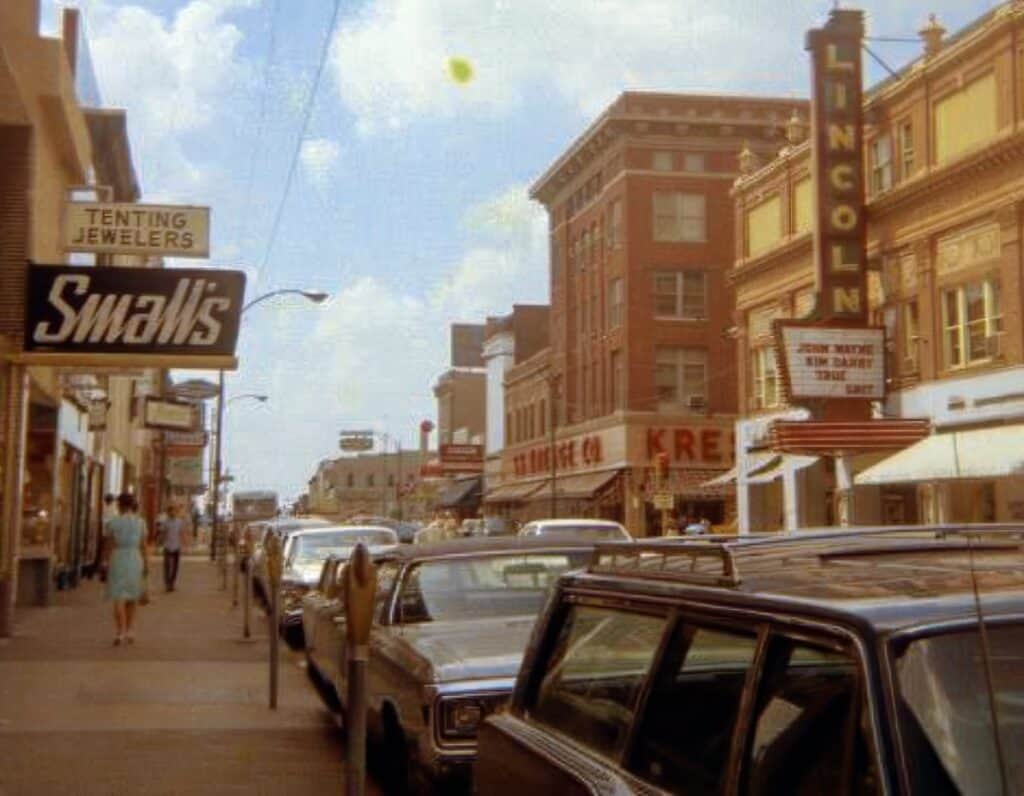
Belleville, Illinois, in the early 1950’s
Growing up in a typical Irish Catholic family, being precisely the middle child in a family of seven children, I had an older and a younger brother, and two older and two younger sisters. My recollections of youth are typically memories of happiness and loving care within a mildly austere home life setting.
As with so many other families in those times, the stock market crash of 1929 had forced my father, as a high-schooler, to drop out and work as a laborer for the Aluminum Ore Company in East Saint Louis. As “the man of the house,” he had to support his parents and three sisters through the financial crisis which denied him the opportunity to pursue a higher education. Subsequently, he spent an entire career as a Mobil oil refinery laborer in East Saint Louis, working his way through the ranks, as such, eventually retiring in his 60’s from a low-level management position.
As my father labored, so too did my dear mother at home, struggling to feed, clothe, bathe, educate, and provide laundry services for seven kids, and to do it all within the minimal budget provided from Dad’s Mobil Oil Corporation income. The family dined on countless dinners of “hamburger hash” and other budget meals, after which arguments ensued among the children over how to carve up the flavors from our weekly half-gallon of Neapolitan ice cream among the eight of us. On the bounty side, I recall being ecstatic over the generous offerings of hand-me-down clothes we received from more fortunate cousins. They never really fit, but I wore those slacks-too-long and shoes-too-big-for-me with pride, even as I stumbled awkwardly along in them to school.
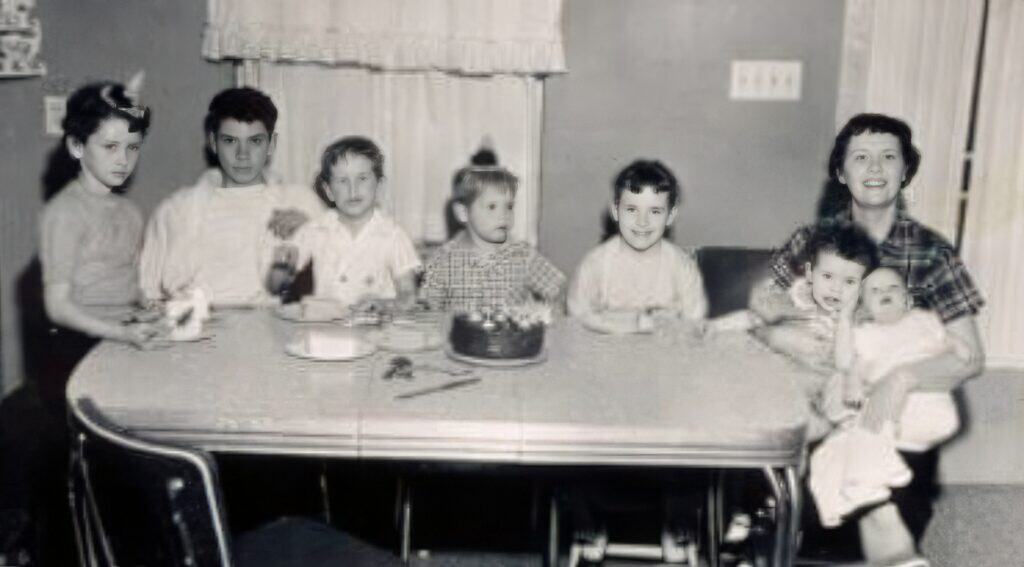
Dan is 3rd from the left, sitting next to his older brother, Bob
Our “army of nine” family workers harvested many fruits and vegetables from our backyard garden, which Mom would “put up,” as she said, in Mason jars stored in the basement. Dad picked up our fresh, unpasteurized milk, direct from the cow, at Heat’s dairy farm each week in gallon containers, and every several months Streck’s Butchery would slice up a hind quarter of beef for storage in our basement freezer.
We offspring each had our assigned household chores — as dishwasher, janitor, garbage man, babysitter, and lawn and garden service employee — for which we were paid a whopping income of 25 cents a week. My younger brother and I came up with some additional income by cashing in old soda bottles, providing us money for candy and second-hand Superman, Batman, and other super-hero comic books we purchased for a penny apiece at a pawn shop in Belleville.
In those days, dissent was a truly rare commodity. In general, people implicitly trusted our federal government — or, in the rare cases when they didn’t, they were considered “cranks.” It was unthinkable to most Americans that our elected officials would ever lie to us. They were almost mythic figures, almost real-life “super-heroes” to many of us in those earnest, more innocent times. We knew we were in good hands and most of us, most of the time, lived for our family and community life.
I can still wax nostalgic about the days of my youth, so many decades later. I remember, I think it was in 1962, we as grade school students marching up to the Old Courthouse on West Main Street to watch the motorcade of President John F. Kennedy pass by on the way to the square. There, our new President delivered a speech to which I paid rapt attention. I liked JFK since he was the first Catholic elected President and was Irish, just like me!
Every summer, I lived at the Belleville Swimming Pool on a $5.00 season pass, at the time a king’s ransom for me, but worth it. I rode my bike to the pool every day to go swimming.
I also used to bowl a lot at the Bel Air Bowl, yet I wasn’t very good at it. At his urging, I once joined a league with my pal, Harry Pseminaki, as my partner. But he ended up being very vexed with me over my frequent gutter balls and low scores. Therefore, I dropped out after one season.
Once in a while, when Dad had enough monetary breathing space, we would all pile into the car for the treat of treats, a ride down to Reeb’s Quality Dairy for an order of malts and ice cream cones which we avidly consumed in the car.
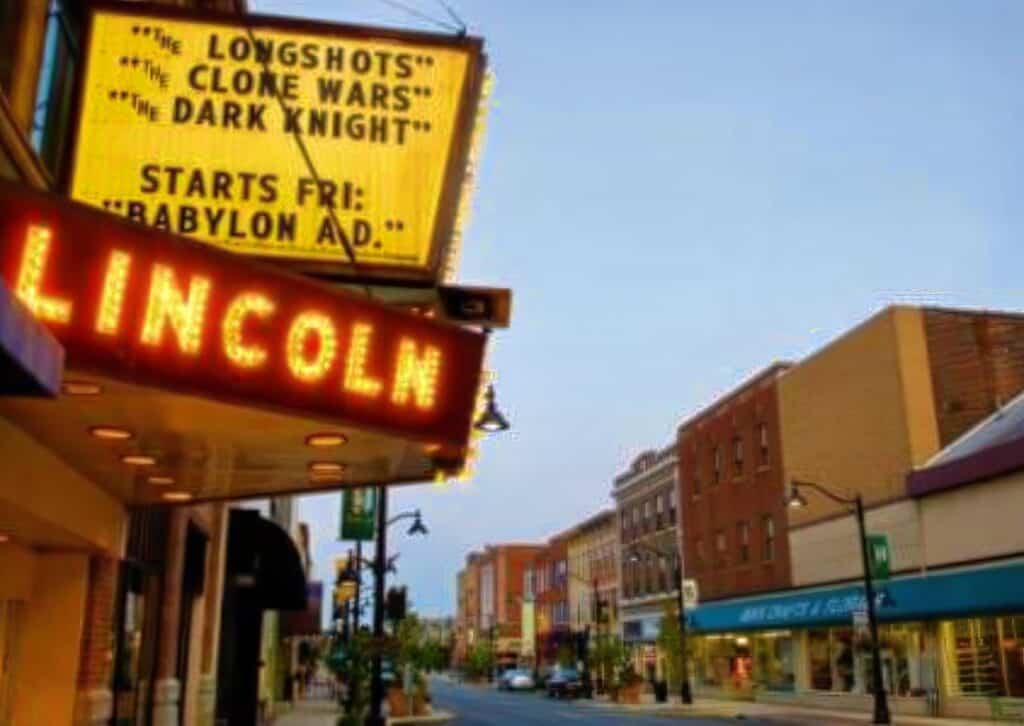
Lincoln Theater in Belleville
I managed to take in some movies at the Lincoln Theater and the Skyview Drive-In. In my teens, my buddy Jim Hamann and I took in every new movie that came to town, going to the Lincoln or to the Ritz Theater. The Skyview Drive-In was another type of family-outing treat, pulling up to a speaker on a pole and hooking it over a half rolled-down window to conduct tinny audio into the car. We packed our own snacks from home for these trips; the concession stand was just too expensive. When we arrived, it was usually dusk as we staked out our viewing position. We kids would use the playground equipment set up beneath the huge outdoor movie screen, until the previews of coming attractions began to roll.
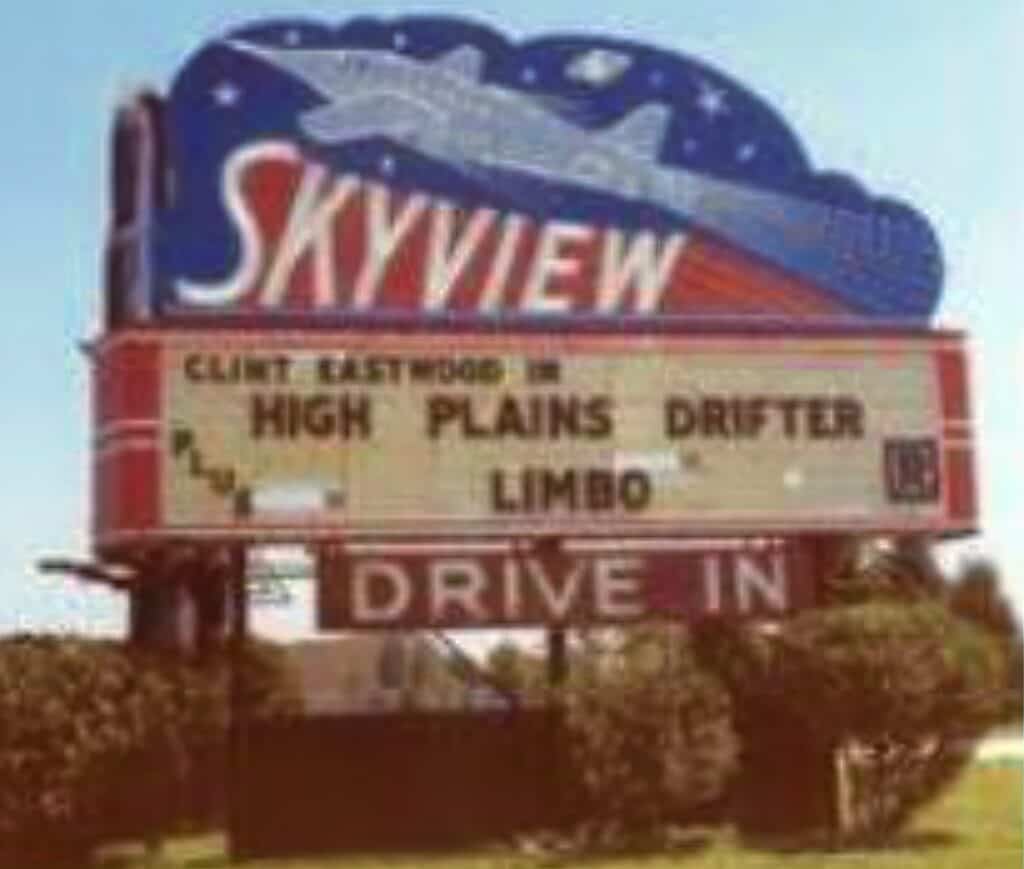
Skyview Drive-In Theater in Belleville
This mid-century American dream we lived, all across the country in places like Belleville, was born in Hollywood, it seemed, and beamed to the Hanley family in our basement via a 7-inch, black-and-white screen set in a television console the size of a small, modern-day refrigerator. Along with many other families longing for the peace, tranquility and pristine lifestyle of those TV households, we chronically viewed network series such as Leave It to Beaver, Father Knows Best, and Ozzie and Harriett. With hindsight, the familiar characters endured seemingly trivial problems, by today’s standards. We admired them, nonetheless, and tried to model our behaviors after them.

Our 7-inch black & white screen television
On thrilling Friday and Saturday nights, we watched reruns of World War II in which movie “hero,” John Wayne, would lead the charge up the hill in Iwo Jima, or take command of the “Flying Tigers” squadron, assisting China in their air battle against pre-Pearl Harbor Japan.
Then, on Saturdays, our youthful army of friends would join my younger brother and me in the woods adjacent to our house as “weekend warriors,” adorned with plastic army helmets, rifles, and back packs, to re-enact these amazing feats of “heroism” — having learned, of course, from our television sets that war solves all the really big problems. “Bang-bang! You’re dead!” we would shout as we got the drop on each other, commanding our “opponents” to lie down. The dead were the losers. The living prevailed, in victory. Problem solved!
We little kids were clueless.
President Eisenhower’s Warning about the Military-Industrial Complex

I remember vaguely puzzling over the Farewell Address to the nation delivered from the White House by then-President Dwight D. Eisenhower, former Supreme Commander of the Allied armed forces in World War II, on January 17, 1961. For some reason we couldn’t quite grasp that he saw fit to deliver a warning to US citizens of the dangers of something he called “the military-industrial complex,” as follows:
Until the latest of our world conflicts, the United States had no armaments industry. American makers of plowshares could, with time and as required, make swords as well. But now we can no longer risk emergency improvisation of national defense; we have been compelled to create a permanent armaments industry of vast proportions. Added to this, three and a half million men and women are directly engaged in the defense establishment. We annually spend on military security more than the net income of all United States corporations.
This conjunction of an immense military establishment and a large arms industry is new in the American experience. The total influence — economic, political, even spiritual — is felt in every city, every state house, every office of the Federal government. We recognize the imperative need for this development. Yet we must not fail to comprehend its grave implications. Our toil, resources and livelihood are all involved; so is the very structure of our society.
In the councils of government, we must guard against the acquisition of unwarranted influence, whether sought or unsought, by the military-industrial complex. The potential for the disastrous rise of misplaced power exists and will persist.
We must never let the weight of this combination endanger our liberties or democratic processes. We should take nothing for granted. Only an alert and knowledgeable citizenry can compel the proper meshing of huge industrial and military machinery of defense with our peaceful methods and goals, so that security and liberty may prosper together.
Akin to, and largely responsible for the sweeping changes in our industrial-military posture, has been the technological revolution during recent decades.
In this revolution, research has become central; it also becomes more formalized, complex, and costly. A steadily increasing share is conducted for, by, or at the direction of the Federal government.
Today, the solitary inventor, tinkering in his shop, has been overshadowed by task forces of scientists in laboratories and testing fields. In the same fashion, the free university, historically the fountainhead of free ideas and scientific discovery, has experienced a revolution in the conduct of research. Partly because of the huge costs involved, a government contract becomes virtually a substitute for intellectual curiosity. For every old blackboard there are now hundreds of new electronic computers.
The prospect of domination of the nation’s scholars by Federal employment, project allocations, and the power of money is ever present and is gravely to be regarded.
Yet, in holding scientific research and discovery in respect, as we should, we must also be alert to the equal and opposite danger that public policy could itself become the captive of a scientific-technological elite.
It is the task of statesmanship to mold, to balance, and to integrate these and other forces, new and old, within the principles of our democratic system, ever aiming toward the supreme goals of our free society.
The words of the wise old General President Eisenhower, as seen from the perspective of a subsequent half-century and more of civic hindsight, were prescient. The conscientious citizen of our current times has long since recognized that the “task of statesmanship” President Eisenhower outlined in this speech has actually failed. Everywhere we look in American society today, if we have but eyes to see, every item on Eisenhower’s warning list that he delivered to the nation that day has long-since become a fact of life.
But the only thing we understood at the time was that former General Eisenhower was the hero-savior of North Africa and Europe, rescuing them and all the world from the evil clutches of German General Rommel and Hitler’s Nazi Germany. That was all we needed or wanted to know, and, of course, we celebrated it.
Finishing High School and Dreaming about Flying
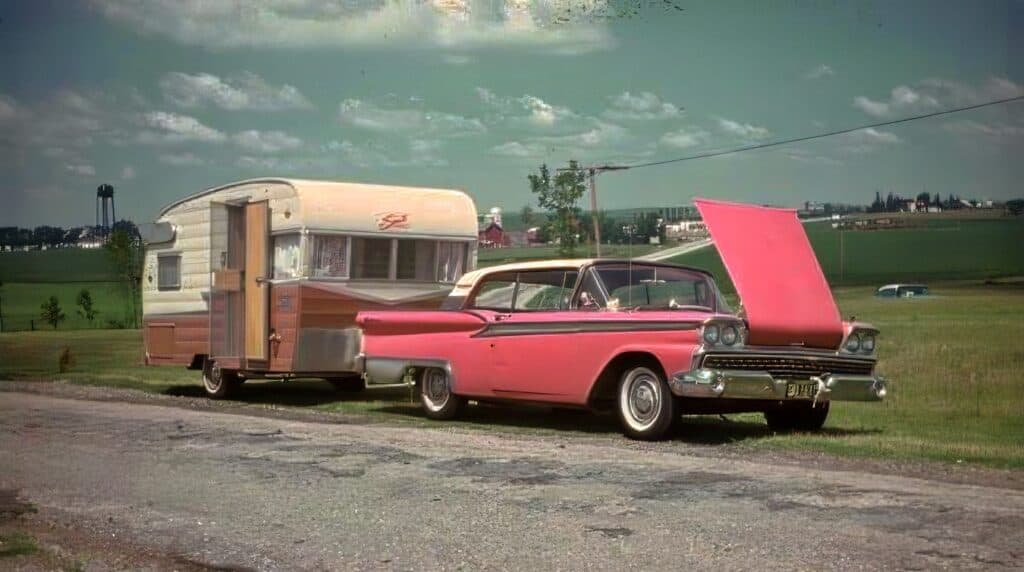
Our one vacation to Denver with Ford Fairlane & Shasta trailer
Special occasions like family reunions, or church, and Mobil Oil Company picnics, were frequent, yet we had only one single vacation in all our years together as a family that actually took us out of town. When I was thirteen years of age, our old, non-air-conditioned Ford Fairlane pulled a Shasta trailer that slept six from Belleville, through the summer heat of Kansas, to the wonderland of Denver, Colorado. In subsequent years, infrequent visits across the Mississippi to Saint Louis instilled in me the belief that I had experienced “life in the fast lane” in a big city!
Meanwhile, with limited income to support our education, our wonderful parents still managed to fork out tuition for our Catholic grade and high school educations. In those days, part of what they paid for was the administration of corporal punishments in which nuns and priests at the St. Augustine of Canterbury grade school meted out “physical tortures” — face-slapping, neck-pinching, and bottom-paddling — for the smallest infractions of discipline.
St. Augustine of Canterbury grade school
Morning mass, followed by the Pledge of Allegiance to the flag in each classroom, was the typical order of the day, each and every day.
“I pledge allegiance to the flag of the United States of America, and to the Republic, for which it stands: one Nation, under God, indivisible, with Liberty and Justice for all.”
Cub Scouts also had me pledging allegiance to the American flag, while instilling in me a sense of patriotism and camaraderie as I worked closely with fellow den members on group projects.
All of life as we lived it seemed to have something important to teach us in those days, sometimes the positive, sometimes the negative. Little league baseball taught me individual and team effort and discipline through hard work and practice. By contrast, football taught me — a skinny, lightweight 100-pound twelve-year-old — the meaning of a “near-death” experience while being trampled or dragged down the field, clinging to the ankle of a 200-pound running back. (The ultimate lesson here was: we are not all cut out to be football super-heroes.) As I took stock, with my head still on my shoulders, the loose teeth in my mouth and cleat marks on my shins, prudence and sound judgment convinced me to retire, physically intact, from the gridiron after one season.
Precise, word-for-word memorization of the Catholic Baltimore Catechism was also mandatory discipline. The Catechism covers 38 Chapters concerning three main topics: The Creed, The Commandments, The Sacraments and Prayer, fusing moral precepts and religious doctrine directly to the grey matter of our brains, never to be forgotten, and subliminally employed throughout our lives as adults.
Commercial aviation was coming of age at the time. My father was invited a few times to attend Mobil Oil safety meetings in New York, with airfare and accommodations provided by his company. He would return from these meetings excited, eager to recount to the family his airplane flight adventures. That first time in 1956, I was a fascinated seven-year-old with many questions regarding his flight to such an exciting destination as New York City.
Soon enough, enamored by the glamour and excitement of air travel, and not having travelled myself at that young age, I conjured up my own makeshift “cockpit” in the basement tool room by painting a cardboard box with a flat black paint. Then, I rigged Christmas light bulbs in holes on top of the box as my enunciator “warning light” panel, an alarm clock in the center served as my “altimeter,” and I inserted a ruler with a wire on it as my “throttle,” I would align old chairs behind me in the basement and induce my playmates to serve as “passengers” while I, as the “captain,” flew them safely to their destination. In my youthful innocence, I did not, however, force them to pay for substandard meals, nor charge them for additional baggage. My simulated “landings” were, needless to say, always perfect.
When I was eight years of age, I exuberantly jumped off my dad’s garage roof, just to momentarily experience the exhilarating feeling of flight, or skydiving from an airplane. I would also spend my leisure time building airplane plastic models which my dad would hang from my bedroom ceiling for all to admire.

Some of my model airplanes that hung from my bedroom ceiling
A neighbor, Woody Woodrow, was a former World War II Naval aviator-turned-barnstorming pilot. He lived right across the street from my parents and built airplanes in his garage. My visits there, along with the old John Wayne movies, of course, were my source of basic understanding for building my cardboard instrument panel. A multi-talented craftsman, Woody had restored an old Steerman biplane, and he often would fly it to provide an air show over our subdivision, with a routine, legally-questionable buzz of our house at 50 feet above the ground.
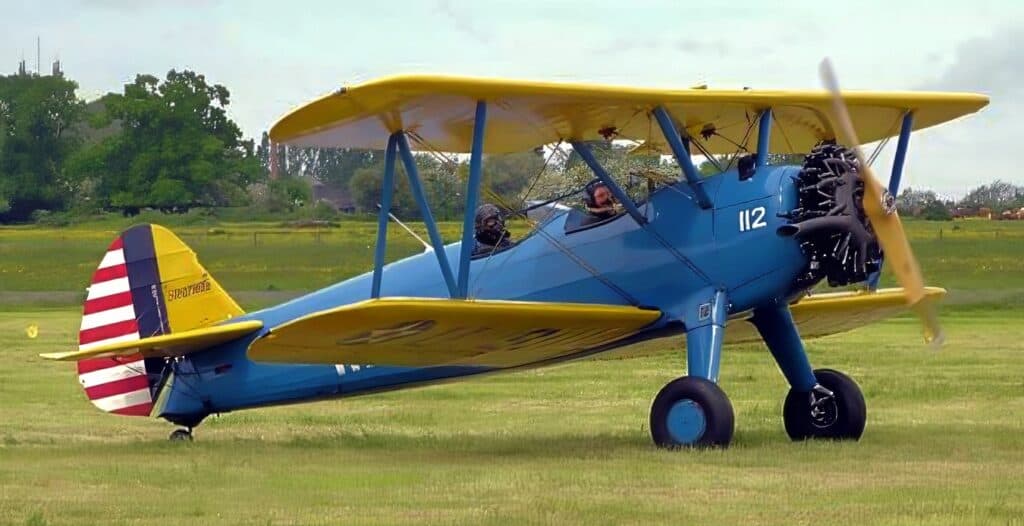
Stearman biplane similar to the one Woody Woodrow restored
I recall lying on my back on new-mown grass in the backyard, wondering what life looked like “up there,” while hoping that someday Woody would take me aloft in his plane, to dance atop the white cumulous clouds. He always promised me that he would — but he never delivered. In retrospect, I think I probably would have just gotten my first taste of airsickness at a very early age. That might have altered the entire course of my life.
As it was, in the mid-1960’s, while academically struggling through Belleville’s Althoff Catholic High, I was rudderless concerning my career choice.
Throughout my high school years, I was a member of the Catholic Youth Organization (CYO), which included monthly social meetings and entrance to the CYO Center in downtown Belleville. This was the meeting place for students, decked out with pool and ping pong tables, pin ball machines, a TV room, a snack bar, and featuring weekend dances which included live band entertainment. Being quite shy at the time, I would join my friends — the wallflowers, in other words — at one end of the hall, too embarrassed to try dancing, and not knowing how to converse with “women.”

Althoff High School in Belleville
As the Beatles crashed wildly onto the music scene, with me being one of their many fans, I longed to dance to their music at the CYO dances. But I simply could not convince my feet to approach a girl, nor my vocal cords to utter the right words. Thus afflicted, I stayed glued to the wall, like a good “flower,” and just watched others have all the fun. At the time, it did not even strike me as ironic that I, who wished to soar, fearlessly, thousands of feet above the earth, succumbed so easily to being paralyzed with dread when the “warning lights” of “sin” and “danger,” programmed relentlessly into me for years, flashed at the thoughts of merely trying to talk to a girl!
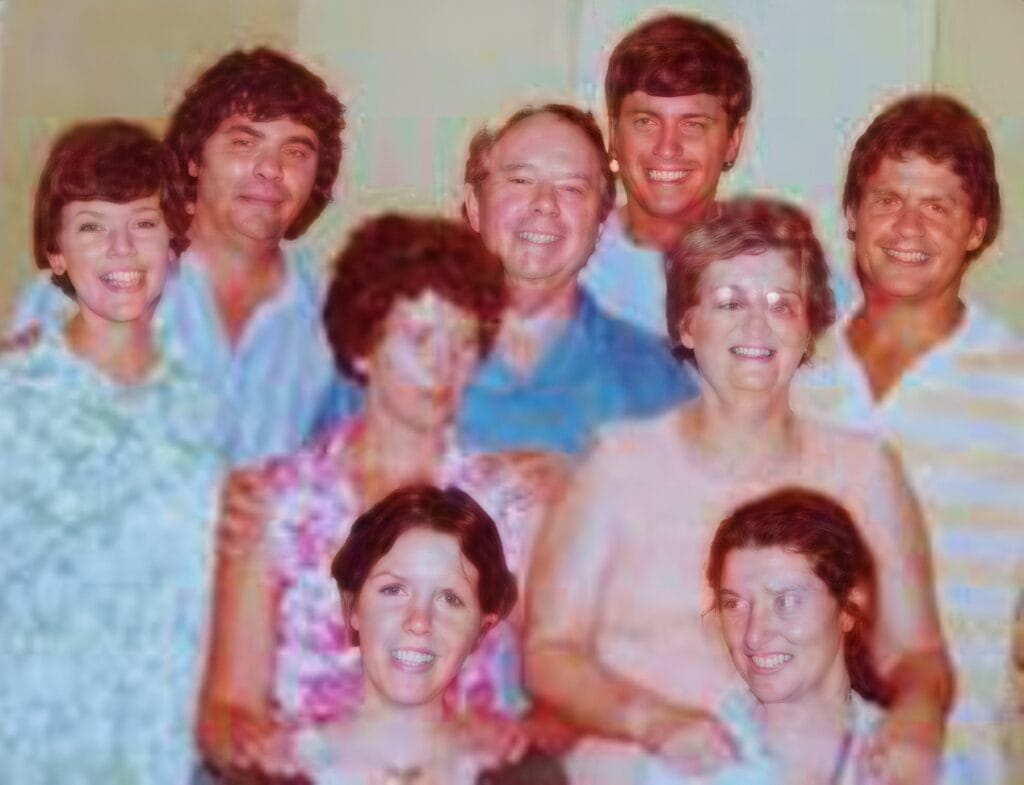
Dan is standing in the back between his Dad & Mom
In early 1967, my two-years-older sister and her friend convinced my parents to allow them to drive to New Orleans for Mardi Gras, and to take my friend and me along, serving as our “adult chaperones.” Not having been on a vacation out of Illinois, other than the trailer trip to Denver with my parents, I was overjoyed when they agreed. After having driven the eighteen-hour, all-night trip there, we hiked around, knee-deep in beer cans, amongst thousands of out-of-control college students who were being “brought back under control” by the horse-mounted police tapping on their heads with clubs. It all amounted to a monstrously exhilarating experience. This trip convinced me that I needed to see the rest of the world, versus the default option, living in Belleville for the remainder of my years on earth.
Just as my 1967 high school graduation approached, with my own career path yet undecided, my older sister, Jane, landed a Delta Airlines “stewardess” job based in Memphis. My envy of her skyrocketed on numerous counts. I would drive with my parents to Lambert Field in St. Louis to pick her up on her return trips home; then, with the permission of a ticket agent and cockpit crew, I would climb the stairs of a DC-6 or DC-9 aircraft to pester the pilots with many questions. Without exception, I would always query them as to how they qualified for employment as an airline pilot, and the answer was always the same: “Go in the military, kid.”

DC-6 cockpit
The airlines simply were not hiring at the time, and with the returning military pilots from the US war in Viet Nam flooding the market, I began to sense that my chances of success in pursuing this path were slim to none. Besides, I also recognized that, with the very limited income Mobil Oil provided to my dad, the possibility of coming up with the tuition money to pay for civilian flight training also seemed a mere flight of fancy.
Meanwhile, the Viet Nam War was raging. Many of my fellow students volunteered for military service before their high school graduations. Unlike when “playing war” in my youth, the names of neighbors who enlisted began appearing in the obituary column of The Belleville News Democrat, driving home a stark truth to me: the portrayal of war as the solution to all problems was farcical. We had to acknowledge the personal feats of heroism of our uniformed fighting men as reported in the news, yet it was the dead bodies of these selfsame heroes being delivered to the neighboring Scott Air Force Base in Illinois which led me to observe: Some homecoming!
Such thoughts inhabited my mind often, in part because our house lay directly beneath the Scott AFB landing pattern, so the continuous daily flow of Military Airlift Command C-9 Nightingale hospital planes overhead, returning the dead and wounded from Southeast Asia, brought the sobering ugliness of war home to me in a very real way. With billions of tax dollars being spent on the defense industry, and with “acceptable calculated loss of human life” figures being published in the news — the lives lost, sometimes just to temporarily regain control of a single hill in South Viet Nam — Eisenhower’s warning of the “unwarranted power” of the military industrial complex emerged a little more into focus, right before our eyes.
Yet, with the military draft in full swing, I began entertaining the notion of being drafted into the Army, obviously hoping to return alive from Viet Nam, then complete civilian flight training via college tuition paid for returning war vets by the GI Bill. “If you want to get ahead in life, you have to get a good education, Dan,” my dad always told me. I had seen what the limitations of his Depression-era background, which forced him to curtail even his high school education, meant to him and to the family. A career track in all branches of the military, with the exception of the Army warrant officer program, required a four-year degree prior to acceptance.
At the time, the thought of entering the labor field or a 9-to-5 office job as a career was very demoralizing to me, since I could not identify any field that I thought would be challenging, rewarding, and exciting. My dad pleaded with me to continue with my education, but as a poor high school student who barely passed algebra and trigonometry, I was certain that I would not sustain the required “C” college grade point average that ensured deferment from the Army selective service draft system.
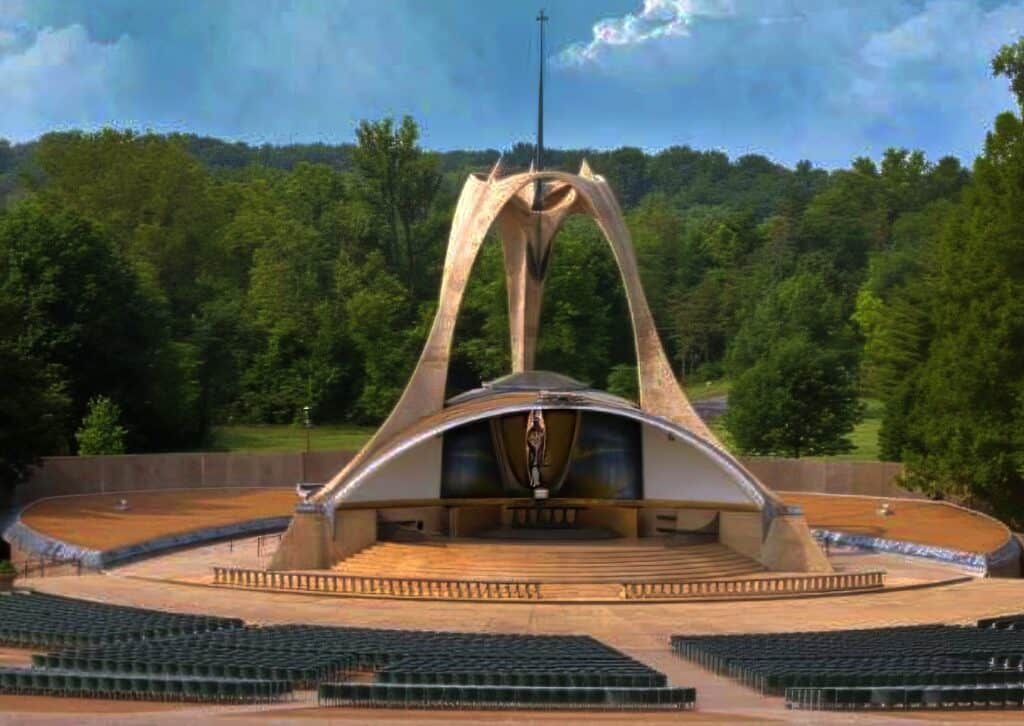
Janitor & part-time altar boy at the Catholic Shrine of Lady of Snows
What followed was a two-year stint as a janitor and part-time altar boy employee at the Catholic Shrine of Lady of Snows in Belleville while in high school. These experiences convinced me that this type of work was “not my forte,” as the massive floor buffer wrestled my frail frame into walls and candle stands on a daily basis. There were no casualties, although at times I almost took out a few church patrons who inadvertently stood in the path of my runaway floor buffer. However, these jobs provided me with sufficient entertainment income during my high school years. It was these brief work experiences, coupled with work around the house, that taught me a work ethic at an early age, while also convincing me that servile labor, while great exercise, was not a career path I was willing to travel.
It was during the summer of 1967 that my parents finally convinced me to at least give college a shot and see where life would take me from there. Ofttimes, the seemingly simple choices that we make at critical junctures in our life have profound consequences over the course of time. In this case, the search for a means of attending college led me to discover a door through which I might pass and fulfill my childhood dream of becoming an airplane pilot.